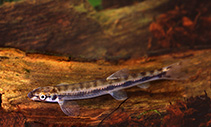
Ambiente: milieu / zona climatica / distribuzione batimetrica / gamma di distribuzione
Ecologia
; acqua dolce demersale; pH range: 7.0 - ? ; dH range: 5 - 15. Tropical; 20°C - 22°C (Ref. 2059)
Africa: Wami and Ruvu drainages in Tanzania (Ref. 26644).
Dimensione / Peso / Età
Maturità: Lm ? range ? - ? cm
Max length : 5.4 cm SL maschio/sesso non determinato; (Ref. 89309)
Spine dorsali (totale) : 0; Raggi dorsali molli (totale) : 9 - 11; Spine anali: 0; Raggi anali molli: 8 - 9. Diagnosis: body depth 7 (Ref. 1878) - 11.4 (Ref. 26644) times in TL, 5.9-9.4 times in SL (Ref. 26644). Head as broad as deep, 2 times as long as broad (Ref. 1878), its length 5.4-6.4 times in TL and 4.4-5.1 times in SL (Ref. 26644). Snout length 32.9-40.7% HL (Ref. 26644). Eye lateral, just visible from below (Ref. 1878), 4-5.3 times in HL, 19-25% HL (Ref. 26644). Interorbital width 40-46.9% HL (Ref. 26644). Dorsal fin origin at equal distance from anterior border of eye, centre of eye (Ref. 1878) or snout tip (Ref. 3022) and from root of caudal. Predorsal length 54.8-59% SL (Ref. 26644). Anal fin origin a little nearer root of caudal than root of ventrals (Ref. 1878, 89309). Preanal length 76.1-79.3% SL (Ref. 26644). Pectoral a little shorter than head (Ref. 1878, 3022), longer than pelvic (Ref. 3022), 14.9-21.6% SL (Ref. 26644). Pelvic fin 11.6-17.7% SL (Ref. 26644). Caudal peduncle nearly twice as long as deep (Ref. 1878), its length 13-16.3% SL and 63.0-77.9% HL (Ref. 26644). Distinct coloration consisting of rounded dark olive spots on the back (Ref. 26644).
Body shape (shape guide): elongated; Cross section: circular.
Maximum total length recorded is 61.9mm (Ref. 26644). Inhabits upland streams and pools; hardy, can survive some time out of water (Ref. 4967). Omnivorous, feeding on algae, small insect larvae and crustaceans, but preferring algae if present (Ref. 26644).
Ciclo vitale e comportamento di accoppiamento
Maturità | Riproduzione | Deposizione | Uova | Fecondità | Larve
Seegers, L., 1995. Revision of the Kneriidae of Tanzania with description of three new Kneria species (Teleostei: Gonorhynchifromes). Ichthyol. Explor. Freshwat. 6(2):97-128. (Ref. 26644)
Stato della Lista Rossa IUCN (Ref. 130435: Version 2025-2 (Global))
Minaccia per l'uomo
Harmless
Usi umani
Pesca: pesca di sussistenza
Strumenti
Rapporti speciali
Scarica XML
Fonti Internet
Stime basate su modelli
Indice di diversità filogenetica (Fonte Biblio.
82804): PD
50 = 0.5000 [Uniqueness, from 0.5 = low to 2.0 = high].
Bayesian length-weight: a=0.00389 (0.00180 - 0.00842), b=3.12 (2.94 - 3.30), in cm total length, based on all LWR estimates for this body shape (Ref.
93245).
Vulnerabilità della pesca (Ref.
59153): Low vulnerability (10 of 100).
🛈