>
Gonorynchiformes (Milkfishes) >
Kneriidae (Shellears)
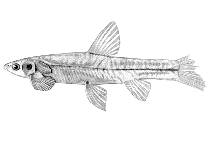
Etymology: Kneria: From Kner, that studied fishes in the Imperial Museum of Vienna, with Jean Natterer (1817) (Ref. 45335); sjolandersi: The name is dedicated to Mr. David Sjölanders of the 1948-49 Angola Expedition of the Göteborg Museum (Ref. 11970).
Eponymy: Dr Rudolf Kner (1810–1869) was an Austrian zoologist specialising in ichthyology. [...] David Sjölanders (1886–1954), aka Sjölander, was a Swedish adventurer, conservationist and nature photographer, who led the Angola Expedition (1948–1949) that collected the holotype. [...] (Ref. 128868), visit book page.
More on author: Poll.
Ambiente: milieu / zona climatica / distribuzione batimetrica / gamma di distribuzione
Ecologia
; acqua dolce benthopelagico. Tropical
Africa: Rio Cubal (Bero River tributary) and streams in the Serra da Chela mountains (part of the Bero and possibly also Coroca River drainages) in Angola (Ref. 11970).
Dimensione / Peso / Età
Maturità: Lm ? range ? - ? cm
Max length : 6.8 cm TL maschio/sesso non determinato; (Ref. 3565)
Breve descrizione
Chiavi di identificazione | Morfologia | Morfometria
Spine dorsali (totale) : 0; Raggi dorsali molli (totale) : 10 - 11; Spine anali: 0; Raggi anali molli: 10 - 11. Diagnosis: body relatively compact, with short and wide head (body height 4.5-5.85 times and head length 4.25-5.7 times in SL); snout length 2.95-3.75 times in HL; eye small, its diameter 3.85-5.0 times in HL, 1.15-1.45 times in snout length; interorbital distance 2.75-3.15 times in HL; male opercular organ with small, concentric protuberances; dorsal fin origin slightly closer to caudal fin origin than to tip of snout and slightly behind pelvic fin origin; anal fin base 1-1.4 times further from pelvic fins than from caudal fin origin; pectoral fin 1-1.2 times and pelvic fin 1-1.15 times in HL; caudal peduncle short, less than 2 times longer than deep (Ref. 11970).
Body shape (shape guide): elongated; Cross section: circular.
Ciclo vitale e comportamento di accoppiamento
Maturità | Riproduzione | Deposizione | Uova | Fecondità | Larve
Poll, M., 1984. Kneriidae. p. 129-133. In J. Daget, J.-P. Gosse and D.F.E. Thys van den Audenaerde (eds.) Check-list of the freshwater fishes of Africa (CLOFFA). ORSTOM, Paris and MRAC, Tervuren. Vol. 1. (Ref. 3565)
Stato della Lista Rossa IUCN (Ref. 130435: Version 2025-2 (Global))
Minaccia per l'uomo
Harmless
Usi umani
Strumenti
Rapporti speciali
Scarica XML
Fonti Internet
Stime basate su modelli
Indice di diversità filogenetica (Fonte Biblio.
82804): PD
50 = 0.5000 [Uniqueness, from 0.5 = low to 2.0 = high].
Bayesian length-weight: a=0.00389 (0.00180 - 0.00842), b=3.12 (2.94 - 3.30), in cm total length, based on all LWR estimates for this body shape (Ref.
93245).
Vulnerabilità della pesca (Ref.
59153): Low vulnerability (10 of 100).
🛈