>
Gonorynchiformes (Milkfishes) >
Kneriidae (Shellears)
Etymology: Kneria: From Kner, that studied fishes in the Imperial Museum of Vienna, with Jean Natterer (1817) (Ref. 45335).
Eponymy: Dr Rudolf Kner (1810–1869) was an Austrian zoologist specialising in ichthyology. [...] (Ref. 128868), visit book page.
More on author: Steindachner.
Ambiente: milieu / zona climatica / distribuzione batimetrica / gamma di distribuzione
Ecologia
; acqua dolce benthopelagico. Tropical
Africa: Kwango drainage (middle Congo River basin) in Angola (Ref. 1878). Also reported from the Kunene and (upper) Zambezi systems (Ref. 13332), although presence in the latter is questionable in Ref. 120641. Presence in the Okavango (Ref. 13332) and southern Kasai (Ref. 45616) uncertain, although considered present in the southern Congo basin in Angola in Ref. 120641.
Dimensione / Peso / Età
Maturità: Lm ? range ? - ? cm
Max length : 9.0 cm TL maschio/sesso non determinato; (Ref. 3565)
Breve descrizione
Chiavi di identificazione | Morfologia | Morfometria
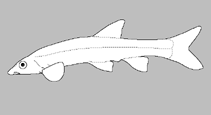
Spine dorsali (totale) : 0; Raggi dorsali molli (totale) : 9 - 10; Spine anali: 0; Raggi anali molli: 11 - 12. Diagnosis: body height less than head length (Ref. 3022), the latter 5.5-6 times in total length (Ref. 1878, 3022). Eye lateral, well visible from below (Ref. 1878), its diameter 3-3.66 times in head length (Ref. 1878, 3022). Dorsal fin origin behind pelvic fins (Ref. 1878, 3022). In males, snout with spine-like tubercles (Ref. 1878, 83772). Ventral profile of lower jaw slightly ventrally curved, except in the middle where it is more or less dorsally curved; more than 100 scales on lateral line; blackish grey band from the back of the head to the caudal fin (Ref. 83772). Lateral line origin curving dorsally above opercular organ, the latter not overlying the anterior lateral line (Ref. 88971). Black spot at base of pelvic and pectoral fins; 2 black spots at base of anal fin (Ref. 3022, 83772). Blackish brown spots just above and below lateral line (Ref. 83772).
Body shape (shape guide): elongated; Cross section: circular.
Ciclo vitale e comportamento di accoppiamento
Maturità | Riproduzione | Deposizione | Uova | Fecondità | Larve
Poll, M., 1984. Kneriidae. p. 129-133. In J. Daget, J.-P. Gosse and D.F.E. Thys van den Audenaerde (eds.) Check-list of the freshwater fishes of Africa (CLOFFA). ORSTOM, Paris and MRAC, Tervuren. Vol. 1. (Ref. 3565)
Stato della Lista Rossa IUCN (Ref. 130435: Version 2025-2 (Global))
Minaccia per l'uomo
Harmless
Usi umani
Strumenti
Rapporti speciali
Scarica XML
Fonti Internet
Stime basate su modelli
Indice di diversità filogenetica (Fonte Biblio.
82804): PD
50 = 0.5000 [Uniqueness, from 0.5 = low to 2.0 = high].
Bayesian length-weight: a=0.00389 (0.00180 - 0.00842), b=3.12 (2.94 - 3.30), in cm total length, based on all LWR estimates for this body shape (Ref.
93245).
Vulnerabilità della pesca (Ref.
59153): Low vulnerability (10 of 100).
🛈