Taxonomic Remarks
The high level of genetic divergence between most of the populations in South Africa suggests that it may represent a species complex rather than a single species (Ref. 32965, 93589). There is an urgent need for detailed morphological diagnostic studies, and the determination of the ecological requirements and conservation status of each of the cryptic forms of this species (Ref. 93589).
Ambiente: milieu / zona climatica / distribuzione batimetrica / gamma di distribuzione
Ecologia
; acqua dolce benthopelagico. Subtropical; 18°C - 24°C (Ref. 12468); 30°S - 34°S
Africa: endemic to South Africa, occurs in Cape coastal streams and rivers from the Krom and upper Gamtoos River systems (south coast) to the Clanwilliam Olifants system (west coast)(Ref. 32965, 52193, 93589, 93786).
Lunghezza alla prima maturità / Dimensione / Peso / Età
Maturità: Lm 3.9, range 4 - 4 cm
Max length : 7.5 cm TL maschio/sesso non determinato; (Ref. 52193)
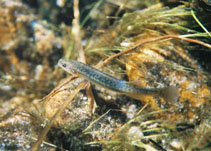
Spine dorsali (totale) : 0; Raggi dorsali molli (totale) : 9 - 13; Spine anali: 0; Raggi anali molli: 9 - 14; Vertebre: 36 - 42. Diagnosis: body slender and cylindrical, without scales; dorsal fin placed far back over anal fin; caudal fin truncated; mouth terminal, jaws with teeth; large eyes; internal organs visible in live specimens (Ref. 52193). Loss of two laterosensory pores beneath the lower jaw; elongate caudal peduncle (Ref. 93822).
Body shape (shape guide): elongated; Cross section: oval.
Facultative air-breathing in the genus (Ref. 126274); May penetrate some distance inland and is widespread in lakes and rivers (Ref. 3563), which may be either acid (pH 5-6,5) or alkaline (pH 8-9) (Ref. 93592, 93822). Prefers gentle currents within shelter of banks near the head of pools (Ref. 3563, 52193). Small but extremely hardy, they are known to tolerate a wide range of water and temperature conditions (Ref. 5214, 6164, 52193, 93591, 93592). Feeds on small drifting invertebrates (Ref. 7248, 52193). Spawning period occurs in spring up to middle of summer (Ref. 5214, 33843, 52193), depending on the conditions (Ref. 52193). Ripe eggs are demersal, relatively large and numbering about 30-40 (Ref. 93592). Their small size and cryptic color enable them to avoid predators (Ref. 52193).
Breeding occurs in spring or summer depending on local conditions (Ref. 52193). Galaxias zebratus does not migrate to the sea for breeding purposes (Ref. 41543, 93592).
Skelton, P.H., 2001. A complete guide to the freshwater fishes of southern Africa. Cape Town (South Africa): Struik Publishers, 395 p. (Ref. 52193)
Stato della Lista Rossa IUCN (Ref. 130435: Version 2025-2 (Global))
Minaccia per l'uomo
Harmless
Usi umani
Pesca: di nessun interesse; Acquario: Commerciale
Strumenti
Rapporti speciali
Scarica XML
Fonti Internet
Stime basate su modelli
Indice di diversità filogenetica (Fonte Biblio.
82804): PD
50 = 0.5000 [Uniqueness, from 0.5 = low to 2.0 = high].
Bayesian length-weight: a=0.00490 (0.00206 - 0.01165), b=3.12 (2.91 - 3.33), in cm total length, based on LWR estimates for this (Sub)family-body shape (Ref.
93245).
Livello trofico (Fonte Biblio.
69278): 3.5 ±0.37 se; based on food items.
Resilienza (Fonte Biblio.
120179): Basso, tempo minimo di raddoppiamento della popolazione 4.5 - 14 anni (Fec<50).
Vulnerabilità della pesca (Ref.
59153): Low vulnerability (10 of 100).
🛈