>
Scombriformes (Mackerels) >
Scombridae (Mackerels, tunas, bonitos) > Scombrinae
Etymology: Rastrelliger: Latin, rastra = rake + Latin, gero = to carry.
Eponymy: James Lawrence Faughn (1910–1985) worked at the Scripps Institution of Oceanography (1947–1974). [...] (Ref. 128868), visit book page.
Environnement : milieu / zone climatique / profondeur / gamme de distribution
Écologie
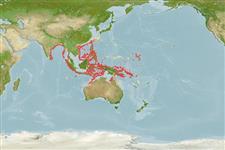
marin pelagic-neritic; océanodrome (Ref. 51243); profondeur 2 - 150 m (Ref. 128967). Tropical; 27°N - 24°S, 79°E - 176°W (Ref. 168)
Indo-West Pacific: India north to Taiwan, and east to Fiji.
Taille / Poids / Âge
Maturité: Lm ? range ? - ? cm
Max length : 24.0 cm FL mâle / non sexé; (Ref. 117079); poids max. publié: 750.00 g (Ref. 168)
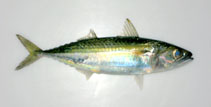
Épines dorsales (Total) : 8 - 11; Rayons mous dorsaux (Total) : 12; Épines anales: 0; Rayons mous anaux: 12; Vertèbres: 31. Head longer than body depth. Maxilla covered by lachrymal bone. Swim bladder present. Interpelvic process small and single. Anal spine rudimentary. Bristles on longest gill raker, 30 to 55 on one side. Gill rakers do not extend far into mouth. A black blotch behind pectoral fin base. The belly is yellowish silver; 2 to 6 large spots are at the base of the first dorsal fin; tow faint stripes are at the level of the lateral line in some specimens.
Body shape (shape guide): fusiform / normal; Cross section: oval.
Epipelagic, neritic species, occurring in waters where surface temperatures do not fall below 17°C. Forms schools of equally sized individuals. Feeds on the largest zooplankton organisms, thus complementing the planktonic food spectrum of the other two Rastrelliger species.
Cycle de vie et comportement reproducteur
Maturité | Reproduction | Frai | Œufs | Fécondité | Larves
Collette, B.B. and C.E. Nauen, 1983. FAO Species Catalogue. Vol. 2. Scombrids of the world. An annotated and illustrated catalogue of tunas, mackerels, bonitos and related species known to date. Rome: FAO. FAO Fish. Synop. 125(2):137 p. (Ref. 168)
Statut dans la liste rouge de l'IUCN (Ref. 130435: Version 2025-2 (Global))
Menace pour l'homme
Harmless
Utilisations par l'homme
Pêcheries: commercial; pêche sportive: oui
Outils
Articles particuliers
Télécharger en XML
Sources Internet
Estimations basées sur des modèles
Température préférée (Réf.
123201): 15 - 22.9, mean 18.3 °C (based on 44 cells).
Indice de diversité phylogénétique (Réf.
82804): PD
50 = 0.6250 [Uniqueness, from 0.5 = low to 2.0 = high].
Bayesian length-weight: a=0.00891 (0.00526 - 0.01511), b=3.04 (2.89 - 3.19), in cm total length, based on LWR estimates for this species & (Sub)family-body (Ref.
93245).
Niveau trophique (Réf.
69278): 3.4 ±0.45 se; based on food items.
Generation time: 0.8 ( na - na) years. Estimated as median ln(3)/K based on 2
growth studies.
Résilience (Réf.
120179): Haut, temps minimum de doublement de population inférieur à 15 mois (K=1.45).
Vulnérabilité de la pêche (Ref.
59153): Low vulnerability (13 of 100).
🛈