वर्गीकरण / नाम
आम नाम | उपशब्द | Catalog of Fishes(वर्ग, प्रजाति) | ITIS | CoL | WoRMS | Cloffa
पर्यावरण: पर्यावरण / जलवायु क्षेत्र / गहराई सीमा / वितरण सीमा
पारिस्थितिकी
; स्वच्छ जल, अलवण जल ड़िमरसल; pH range: 6.0 - 8.0; dH range: 5 - 19. Subtropical; 18°C - 23°C (Ref. 30491)
South America: Argentina, Brazil, and Uruguay.
आकार / वज़न / आयु
परिपक्व अवधि: Lm ? range ? - ? cm
Max length : 6.6 cm SL पुल्लिंग / अलिंग; (Ref. 111771); 7.1 cm SL (female); अधिकतम प्रकाशित वज़न: 11.20 g (Ref. 111771); अधिकतम प्रकाशित वज़न: 11.20 g
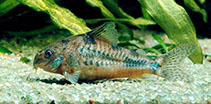
पृष्ठीय रीढ़ (सम्पूर्ण) : 2; पृष्ठीय सौफट रेज़ (सम्पूर्ण) : 8 - 9; ऐनल सौफट रेज़: 6 - 7; जानवरों की रीड़ का जोड़: 21 - 22. This species is distinguished from its congeners, except C. armatus and C. microcephalus, by having perpendicularly directed serrations along the entire posterior margin of the pectoral spines (vs. serrations pointing towards pectoral spine origin, or directed towards pectoral-spine tip, or perpendicularly directed serrations, if present, bifid or restricted to proximal region of pectoral spine); differs from C. armatus by the absence of contact between infraorbital 2 and compound pterotic (vs. presence); differs from C. microcephalus by the presence of a longitudinal series of three large black blotches along midline of flank (vs. four or five midline blotches in C. microcephalus); differs from C. cohui, C. diphyes, C. flaveolus, C. froehlichi, C. gryphus, C. habrosus, C. lacrimostigmata, C. longipinnis, C. lymnades by having the anterior region of the dorsal fin black (vs. with black spots or bars); differs from C. carlae, C. garbei, C. difluviatilis by having hyaline or black pectoral fin (vs. with black spots or bars); differs from C. reynoldsi, C. tukano, C. weitzmani by the absence of a conspicuous coloration pattern in the region of the eye (vs. presence of a transversal black stripe across the eye); differs from C. gladysae, C. micracanthus, C. petracinii by having a dorsal spine that is relatively long, with adpressed distal tip slightly surpassing the base of the last branched dorsal-ray (vs. conspicuously short, with adpressed distal tip not reaching the base of the last branched dorsal-ray); differs from C. ehrhardti by having transversal black bars on caudal-fin lobes (vs. caudal-fin lobes hyaline or brownish); differs from C. steindachneri by having a fold in the middle portion of the lower lip (vs. absence) (Ref. 129023).
Cross section: compressed.
Facultative air-breathing (Ref. 126274); Found in ponds (Ref. 11229). Feeds on worms, crustaceans, insects and plant matter (Ref. 7020). Aquarium keeping: in groups of 5 or more individuals; minimum aquarium size 60 cm (Ref. 51539).
जीवन चक्र और संभोग व्यवहार
परिपक्व अवधि | पुनरुत्पत्ति | मछलीऔ का अंडे देना | अंडे | उपजाऊपन | लार्वा
The female holds 2-4 eggs between her pelvic fins, where the male fertilizes them for about 30 seconds. Only then the female swims to a suitable spot, where she attaches the very sticky eggs. The pair repeats this process until about 100 eggs have been fertilized and attached (Ref. 1672).
Tencatt, L.F.C., M.R. de Britto and C.S. Pavanelli, 2016. Revisionary study of the armored catfish Corydoras paleatus (Jenyns, 1842) (Siluriformes: Callichthyidae) over 180 years after its discovery by Darwin, with description of a new species. Neotropical Ichthyology 14(1):75-94. (Ref. 129023)
आईयूसीएन रेड लिस्ट स्थिति (Ref. 130435: Version 2025-2 (Global))
मनुष्यों के लिए ख़तरा
Harmless
मानव उपयोग
मात्स्यिकी: कोई रुचि बग़ैर; जलजीवालय: उच्च वाणिज्य
साधन
विशेष रिपोर्ट
XML डाउनलोड करें
इंटरनेट स्रोत
मॉडल पर आधारित अनुमान
जातिवृति विविधता सूचकांक (संदर्भ
82804): PD
50 = 0.5000 [Uniqueness, from 0.5 = low to 2.0 = high].
Bayesian length-weight: a=0.01995 (0.01444 - 0.02756), b=2.96 (2.87 - 3.05), in cm total length, based on LWR estimates for this species (Ref.
93245).
ट्रॉफिक स्तर (संदर्भ
69278): 2.9 ±0.34 se; based on food items.
लौटाव (संदर्भ
120179): माध्यम, न्यूनतम जनसंख्या दुगनी होने का समय 1.4 - 4.4 वर्ष। (Fec is at least about 100 eggs (Ref.
1672)).
मछली पकड़ने की भेद्यता (Ref.
59153): Low vulnerability (10 of 100).
🛈