>
Cypriniformes (Carps) >
Botiidae (Pointface loaches) > Botiinae
Eponymy: Dr Yasuhiko Taki (1931-2020) was an Japanese ichthyologist and researcher ‘…who contributed very much’ to the study of loaches, according to the etymology. [...] (Ref. 128868), visit book page.
More on author: Bleeker.
Ambiente: milieu / zona climática / intervalo de profundidade / gama de distribuição
Ecologia
; Água doce demersal; pH range: 6.0 - 8.0; dH range: 5 - 12; potamódromo (Ref. 138296). Tropical; 26°C - 30°C (Ref. 1672)
Asia: Mekong and Chao Phraya basins (Ref. 12693), and Mae Khlong basin (Ref. 12041).
Tamanho / Peso / Idade
Maturidade: Lm ? range ? - ? cm
Max length : 25.0 cm SL macho/indeterminado; (Ref. 27732)
Descrição breve
Chaves de identificação | Morfologia | Morfometria
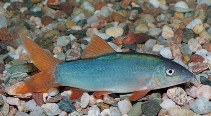
Raios dorsais moles (total) : 12 - 13; Raios anais moles: 8 - 10; Vértebras: 30 - 32. Usually 8 branched dorsal rays; a bluish to greyish body (in life); a dark vertical bar at caudal-fin base and bright orange to red fins in life (Ref. 27732); lacks a mid-dorsal stripe at all ages; large ethmoid spine perpendicular to snout when viewed from above; large mental lobe; young may be iridescent green with numerous narrow black bars (Ref. 12693).
Body shape (shape guide): fusiform / normal.
Usually found in large rivers with a muddy substrate (Ref. 27732). Occurs in flooded fields (Ref. 12975). Feeds at night on worms, crustaceans and insects (Ref. 7020). Oviparous (Ref. 205). A strongly migratory species (Ref. 9497). Above the Khone Falls of the Mekong basin, it migrates into tributaries and small streams, where it spawns during the early flood season. When water starts to recede, it moves back to the main tributaries and to the Mekong mainstream. An upstream migration occurs from the Mekong Delta, around the saline intrusion zone to just below the Khone Falls between November and March. This migration is reportedly triggered by receding water levels. From May to July, the species migrates the opposite way, downstream from the Khone Falls to flooded areas in Southern Cambodia and the Mekong Delta in Viet Nam (Ref. 37770). Two individuals reared in captivity were reported to live up to eight years or more wherein one fish attained a size of 210 g and 9.577 cm SL while the other fish reached 200 g and 10.03 cm SL (Eric Baran, pers. comm., 2015).
Ciclo de vida e comportamento de acasalamento
Maturidade | Reprodução | Desova | Ovos | Fecundidade | Larvas
Oviparous (Ref. 205). Distinct pairing during breeding (Ref. 205).
Kottelat, M., 2004. Botia kubotai, a new species of loach (Teleostei: Cobitidae) from the Ataran River basin (Myanmar), with comments on botiine nomenclature and diagnosis of a new genus. Zootaxa 401:1-18. (Ref. 50472)
Categoria na Lista Vermelha da IUCN (Ref. 130435: Version 2025-2 (Global))
Ameaça para o homem
Harmless
Utilização humana
Pescarias: altamente comercial; Aquário: Altamente comercial
Ferramentas
Relatórios especiais
Descarregue XML
Fontes da internet
Estimativas baseadas em modelos
Índice de diversidade filogenética (Ref.
82804): PD
50 = 0.5078 [Uniqueness, from 0.5 = low to 2.0 = high].
Bayesian length-weight: a=0.01000 (0.00499 - 0.02004), b=2.99 (2.81 - 3.17), in cm total length, based on LWR estimates for this species & (Sub)family-body (Ref.
93245).
Nível Trófico (Ref.
69278): 3.4 ±0.43 se; based on food items.
Vulnerabilidade da pesca (Ref.
59153): Low vulnerability (21 of 100).
🛈