>
Acanthuriformes (Surgeonfishes) >
Pomacanthidae (Angelfishes)
Etymology: Centropyge: Greek, kentron = sting + Greek, pyge = tail (Ref. 45335).
Eponymy: Dr Irenäus Eible-Eibesfeldt (1928–2018) was a German biologist who collected the type in the Nicobar Islands. [...] (Ref. 128868), visit book page.
Umwelt: Milieu / Klimazone / Tiefenbereich / Verbreitungsgebiet
Ökologie
seewasser riff-verbunden; standorttreu; tiefenbereich 3 - 30 m (Ref. 48391). Tropical
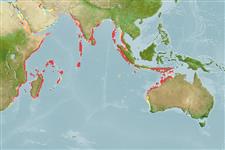
Eastern Indian Ocean: Sri Lanka to Western Australia, including Indonesia and the Andaman Is.
Größe / Gewicht / Alter
Geschlechtsreife: Lm ? range ? - ? cm
Max length : 15.0 cm TL Männchen/unbestimmt; (Ref. 4859)
Rückenflossenstacheln (insgesamt) : 14; Rückenflossenweichstrahlen (insgesamt) : 14 - 16; Afterflossenstacheln: 3; Afterflossenweichstrahlen: 15 - 17.
Body shape (shape guide): short and / or deep; Cross section: compressed.
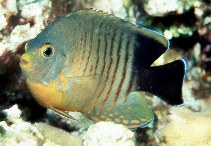
Inhabits rocky areas of seaward reefs as well as rich coral areas (Ref. 9710). Feeds on algae; forms harems of 3-7 individuals. Frequently exported through the aquarium trade. Forms hybrids with Centropyge vrolikii in areas where these 2 species are sympatric, and hybrids with the C. flavissima have been recorded in the Christmas I. and Cocos-Keeling islands in the eastern Indian Ocean. Mimicked by the juveniles of the acanthurid Acanthurus tristis (Ref. 48391).
Lebenszyklus und Paarungsverhalten
Geschlechtsreife | Fortpflanzung | Ablaichen | Eier | Fruchtbarkeit | Larven
Pyle, R., 2001. Pomacanthidae: Angelfishes. p. 3266-3286. In K.E. Carpenter and V.H. Niem (eds.) FAO species identification guide for fishery purposes. The living marine resources of the Western Central Pacific. Volume 5. Bony fishes part 3 (Menidae to Pomacentridae). Rome, FAO. (Ref. 48391)
IUCN Rote Liste Status (Ref. 130435: Version 2025-2 (Global))
Bedrohung für Menschen
Harmless
Nutzung durch Menschen
Fischereien: kommerziell; Aquarium: Kommerziell
Tools
Zusatzinformationen
Download XML
Internet Quellen
Schätzungen auf der Grundlage von Modellen
Bevorzugte Temperatur (Ref.
123201): 25.2 - 29.3, mean 28.3 °C (based on 973 cells).
Phylogenetischer Diversitätsindex (Ref.
82804): PD
50 = 0.5000 [Uniqueness, from 0.5 = low to 2.0 = high].
Bayesian length-weight: a=0.03020 (0.01316 - 0.06929), b=2.89 (2.70 - 3.08), in cm total length, based on LWR estimates for this (Sub)family-body shape (Ref.
93245).
Trophische Ebene (Ref.
69278): 2.7 ±0.40 se; based on food items.
Widerstandsfähigkeit (Ref.
120179): mittel, Verdopplung der Population dauert 1,4 - 4,4 Jahre. (Preliminary K or Fecundity.).
Anfälligkeit der Fischerei (Ref.
59153): Low vulnerability (10 of 100).
🛈
Nährstoffe (Ref.
124155): Calcium = 82.9 [41.8, 130.9] mg/100g; Iron = 0.653 [0.403, 1.072] mg/100g; Protein = 18.2 [17.0, 19.3] %; Omega3 = 0.107 [0.066, 0.170] g/100g; Selenium = 24.3 [13.7, 44.6] μg/100g; VitaminA = 90 [24, 305] μg/100g; Zinc = 1.62 [1.12, 2.33] mg/100g (wet weight);