>
Tetraodontiformes (Puffers and filefishes) >
Monacanthidae (Filefishes)
Etymology: Cantherhines: Greek, kanthos = the outer or inner corner of the eye, where the lids meet, 1646 + Greek, rhinos = nose (Ref. 45335).
Entorno: milieu / zona climática / rango de profundidad / gama de distribución
Ecología
marino asociado a arrecife; rango de profundidad 3 - 50 m (Ref. 3592), usually 3 - 20 m (Ref. 40849). Subtropical; 42°N - 26°S, 98°W - 10°E
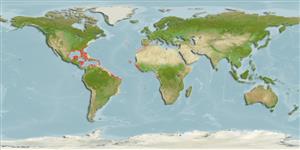
Western Atlantic: Massachusetts (USA), Bermuda, and northern Gulf of Mexico to southeastern Brazil. Eastern Atlantic: São Tomé, Gulf of Guinea (Ref. 3592).
Tamaño / Peso / Edad
Madurez: Lm ? range ? - ? cm
Max length : 20.0 cm TL macho / no sexado; (Ref. 7251); common length : 14.0 cm TL macho / no sexado; (Ref. 3592)
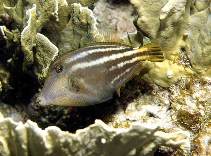
Espinas dorsales (total) : 2; Radios blandos dorsales (total) : 33 - 36; Espinas anales: 0; Radios blandos anales: 29 - 32. First dorsal spine originating over center or front part of eye and followed by a deep groove into which the spine can fold; body with small scattered orange spots, many of which have brown centers, and whitish spots of same size; dull yellow lines on head which run towards snout, those near eye alternating with bluish lines (Ref. 13442).
Body shape (shape guide): short and / or deep.
Found in shallow water and around coral and rocky reefs (Ref. 3790). Usually remains near the bottom, hiding among gorgonians and branching coral (Ref. 9710). Feeds on bottom growth, primarily sponge and algae, but stomach often contain tunicates, bryozoans and other sessile benthic invertebrates (Ref. 5521). The young are pelagic and highly important food items in the diet of large predaceous fishes such as tunas and billfishes (Ref. 3790). Generally considered as trash fish, rarely consumed (Ref. 3790).
Ciclo vital y comportamiento de apareamiento
Madurez | Reproducción | Puesta | Huevos | Fecundidad | Larva
Robins, C.R. and G.C. Ray, 1986. A field guide to Atlantic coast fishes of North America. Houghton Mifflin Company, Boston, U.S.A. 354 p. (Ref. 7251)
Situación en la Lista Roja de la UICN (Ref. 130435: Version 2025-2 (Global))
Amenaza para el ser humano
Reports of ciguatera poisoning (Ref. 30303)
Usos humanos
Pesquerías: pesquerías de subsistencia; Acuario: Comercial
Herramientas
Informes especiales
Descargar XML
Fuentes de Internet
Estimaciones basadas en modelos
Temperatura preferida (Referencia
123201): 23.4 - 28, mean 26.4 °C (based on 402 cells).
Índice de diversidad filogenética (Referencia
82804): PD
50 = 0.5002 [Uniqueness, from 0.5 = low to 2.0 = high].
Bayesian length-weight: a=0.02138 (0.01227 - 0.03725), b=2.89 (2.74 - 3.04), in cm total length, based on LWR estimates for this species & (Sub)family-body (Ref.
93245).
Nivel trófico (Referencia
69278): 2.6 ±0.1 se; based on diet studies.
Resiliencia (Referencia
120179): Alto, población duplicada en un tiempo mínimo inferior a 15 meses (Preliminary K or Fecundity.).
Vulnerabilidad pesquera (Ref.
59153): Low vulnerability (10 of 100).
🛈
Nutrientes (Ref.
124155): Calcium = 26.9 [4.9, 86.5] mg/100g; Iron = 0.924 [0.313, 2.627] mg/100g; Protein = 18.6 [16.3, 20.8] %; Omega3 = 0.125 [0.057, 0.285] g/100g; Selenium = 20.4 [7.1, 61.8] μg/100g; VitaminA = 37.8 [8.8, 168.8] μg/100g; Zinc = 1.4 [0.6, 2.5] mg/100g (wet weight);