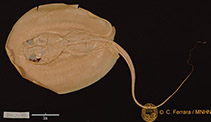
Пластиножаберные (акулы и скаты) (sharks and rays) >
Myliobatiformes (Stingrays) >
Dasyatidae (Stingrays) > Urogymninae
Etymology: garouaensis: Named for its geographical localization (Ref. 39828).
Окружающая среда: среда / климатическая зона / пределы глубины / диапазон распространения
экология
; пресноводный демерсальный. Tropical
Africa: Benue River in Cameroon and Nigeria, and Niger River downstream from its confluence with the Benue River (Ref. 3497, 81259). Also reported from Lagos Lagoon, Cross River and Sanaga River (Ref. 81259, 81625).
Размер / Вес / Возраст
половая зрелость: Lm ? range ? - ? cm
Max length : 40.0 cm WD самец/пол неопределен; (Ref. 3497)
позвонки: 120 - 131. Diagnosis: A moderately large and thin-bodied freshwater dasyatid; disc flatter than in any other West African dasyatid, its depth only 8.7-11.0% of disc width vs. 11.0% or more in other species; denticles on dorsal surface of disc highly variable, sometimes absent, always restricted to central portion; pearl spine absent or represented by 2-3 low denticles (Ref. 26277). It is most similar to the small marine species Dasyatis margaritella and the larger marine species Dasyatis margarita, both of which have well-developed pearl spines and shorter snouts (Ref. 26277).
Body shape (shape guide): other; Cross section: flattened.
Dasyatis garouaensis is restricted to fresh waters (Ref. 81625). Its conservation status is uncertain, given its restricted distribution in a region with known habitat degradation; this species has apparently become less common after the construction of a dam on the Benue River (Ref. 81625). Ovoviviparous (Ref. 50449).
Жизненный цикл и брачное поведение
половая зрелость | размножение | нерест | икра | Плодовитость | личинки
Exhibit ovoviparity (aplacental viviparity), with embryos feeding initially on yolk, then receiving additional nourishment from the mother by indirect absorption of uterine fluid enriched with mucus, fat or protein through specialised structures (Ref. 50449). Distinct pairing with embrace (Ref. 205).
Compagno, L.J.V. and T.R. Roberts, 1984. Dasyatidae. p. 4-5. In J. Daget, J.P. Gosse and D.F.E. Thys van den Audenaerde (eds.) Check-list of the freshwater fishes of Africa (CLOFFA). ORSTOM, Paris and MRAC, Tervuren. Vol. 1. (Ref. 3497)
Статус Красного Списка МСОП (Ref. 130435: Version 2025-2 (Global))
Угроза для людей
Harmless
Использование человеком
дополнительная информация
инструменты
Специальные отчеты
Скачать в формате XML
ресурсы в Интернет
Оценки, основанные на моделях
Индекс филогенетического разнообразия (ссылка
82804): PD
50 = 0.5156 [Uniqueness, from 0.5 = low to 2.0 = high].
Bayesian length-weight: a=0.01023 (0.00482 - 0.02174), b=3.06 (2.86 - 3.26), in cm total length, based on LWR estimates for this (Sub)family-body shape (Ref.
93245).
Трофический уровень (ссылка
69278): 3.7 ±0.3 se; based on size and trophs of closest relatives
устойчивость к внешним воздействиям (ссылка
120179): очень низкий, минимальное время удвоения популяции более 14 лет (Assuming Fec<10).
Уязвимость рыбной ловли (Ref.
59153): Very high vulnerability (90 of 100).
🛈