Entorno: milieu / zona climática / rango de profundidad / gama de distribución
Ecología
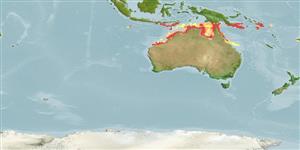
marino bentopelágico, usually 8 - 10 m (Ref. 27621). Tropical; 9°S - 21°S
Western Pacific: northern Australia. Almost certainly present in southern Papua New Guinea.
Tamaño / Peso / Edad
Madurez: Lm ? range ? - ? cm
Max length : 32.0 cm TL macho / no sexado; (Ref. 3132); common length : 20.0 cm TL macho / no sexado; (Ref. 27621)
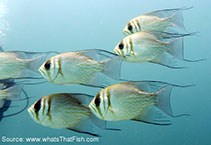
Espinas dorsales (total) : 8; Radios blandos dorsales (total) : 14; Espinas anales: 3; Radios blandos anales: 12. Three dark vertical bands from nape, the first through eye, the second along the edge of the preopercle and the third down to the base of the pectoral fins; Dorsal fin with 8 spines increasing in length from a small anterior spine to a long posterior one; soft dorsal rays 14, much higher than spinous part and with the anterior ray produced into a short filament, the third ray prolonged into a long simple filament which extends past the caudal fin and the fourth and fifth rays also extended to beyond the hypural joint; anal fin with 3 slender spines and 12 soft rays, the second ray prolonged beyond the caudal fin and the third ray almost as long in small specimens.
Body shape (shape guide): short and / or deep; Cross section: compressed.
Inhabit trawling grounds. Found more frequently in moderate depths on the continental shelf particularly close to submerged reefs or rough bottom (Ref. 27621). Feed mainly on crustaceans (Ref. 27621). Some cuttlefish are also taken (Ref. 27621).
Ciclo vital y comportamiento de apareamiento
Madurez | Reproducción | Puesta | Huevos | Fecundidad | Larva
McKay, R.J., 1997. FAO Species Catalogue. Vol. 17. Pearl perches of the world (family Glaucosomatidae). An annotated and illustrated catalogue of the pearl peches known to date. FAO Fish. Synop. 125(17):26p. Rome: FAO. (Ref. 27621)
Situación en la Lista Roja de la UICN (Ref. 130435: Version 2025-2 (Global))
Amenaza para el ser humano
Harmless
Usos humanos
Pesquerías: escaso valor comercial
Herramientas
Informes especiales
Descargar XML
Fuentes de Internet
Estimaciones basadas en modelos
Temperatura preferida (Referencia
123201): 26.7 - 28.8, mean 28 °C (based on 505 cells).
Índice de diversidad filogenética (Referencia
82804): PD
50 = 0.6250 [Uniqueness, from 0.5 = low to 2.0 = high].
Bayesian length-weight: a=0.01995 (0.00906 - 0.04395), b=3.01 (2.83 - 3.19), in cm total length, based on all LWR estimates for this body shape (Ref.
93245).
Nivel trófico (Referencia
69278): 4.1 ±0.48 se; based on food items.
Resiliencia (Referencia
120179): Medio, población duplicada en un tiempo mínimo de 1.4-4.4 años (Preliminary K or Fecundity).
Vulnerabilidad pesquera (Ref.
59153): Low vulnerability (22 of 100).
🛈
Nutrientes (Ref.
124155): Calcium = 89.3 [49.7, 187.5] mg/100g; Iron = 0.754 [0.431, 1.340] mg/100g; Protein = 17.5 [16.4, 18.6] %; Omega3 = 0.207 [0.108, 0.387] g/100g; Selenium = 63.9 [31.1, 136.8] μg/100g; VitaminA = 27.9 [8.0, 98.2] μg/100g; Zinc = 0.988 [0.668, 1.518] mg/100g (wet weight);