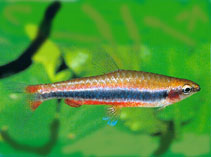
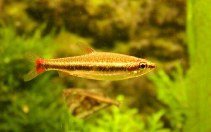
>
Characiformes (Characins) >
Lebiasinidae (Pencilfishes) > Pyrrhulininae
Etymology: Nannostomus: Latin, nannus = small + Greek, stoma = mouth (Ref. 45335).
Eponymy: F J B Beckford (1842–1920) of Winchester was a naturalist and one of the early bee-keepers in Hampshire. He presented the pencilfish holotype to the BMNH, it being part of a collection he had made on the coast of Demerara, British Guiana (Guyana). (Ref. 128868), visit book page.
More on author: Günther.
Taxonomic Remarks
The most recent distributional records were published by Weitzman & Weitzman (1982: Fig. 229). Most recent systematic description by Weitzman (1966). Commonly exported as an aquarium fish since 1910, Stansch (1914). The courtship and other behavior was studied in detail by Caplan & Dunham (1978) and Kuenzer (1982). Probably introduced into rio Jaquraipe, east of Salvador, Bahia Brazil, Géry (1977) and definitely introduced into baía de Guanabara, Rio de Janeiro, Bizerril & Lima (2001). This species is commonly exported as an aquarium fish from Peru and Guyana.
Περιβάλλον: περιβάλλον / κλιματική ζώνη / εύρος βάθους / εύρος διανομής
Οικολογία
; Γλυκού νερού βενθοπελαγικό; pH range: 6.0 - 8.0; dH range: 5 - 19. Tropical; 24°C - 26°C (Ref. 1672)
South America: native in the rivers of Guyana south to the Amazon basin and up the Amazon River to the Negro River.
Μέγεθος / Βάρος / Ηλικία
Γεννητική Ωρίμανση: Lm ? range ? - ? cm
Max length : 6.5 cm SL αρσενικό/απροσδιόριστο; (Ref. 7020)
Inhabits small rivers with little current and in swamps where they are very common. Forms groups where the males dominate to defend their territory. Is highly appreciated by aquarists (Ref. 12225). Feeds on worms, crustaceans and insects (Ref. 7020). Aquarium keeping: in groups of 5 or more individuals; minimum aquarium size 60 cm (Ref. 51539).
Κύκλος ζωής και συμπεριφορά ζευγαρώματος
Γεννητική Ωρίμανση | Αναπαραγωγή | Γεννοβολία | Αβγά | Γονιμότητα | Προνύμφες
At spawning time in captivity, male and female swim alongside one another. Several batches of 1 to 5 eggs are laid among the fine-leaved plants, with a total of up to 200 eggs in some cases; eggs hatch in 30 to 40 hours and fry are free-swimming about six days after (Ref. 7020). Between 24°-27°C, eggs hatch in 24 hours (Ref. 205).
Planquette, P., P. Keith and P.-Y. Le Bail, 1996. Atlas des poissons d'eau douce de Guyane. Tome 1. Collection du Patrimoine Naturel Volume 22, MNHN, Paris & INRA, Paris. 429 p. (Ref. 12225)
Κατάσταση Κόκκινου Καταλόγου IUCN (Ref. 130435: Version 2025-2 (Global))
Απειλή για τον άνθρωπο
Harmless
Ανθρώπινες χρήσεις
αλιεία: Εμπορικό(ά); Υδατοκαλλιέργειες: Εμπορικό(ά); Ενυδρείο: Εμπορικό(ά)
Εργαλεία
Ειδικές εκθέσεις
Λήψη XML
Διαδικτυακές πηγές
Εκτιμήσεις βάσει μοντέλων
Δείκτης φυλογενετικής ποικιλότητας (Αναφ.
82804): PD
50 = 0.5000 [Uniqueness, from 0.5 = low to 2.0 = high].
Bayesian length-weight: a=0.00646 (0.00324 - 0.01288), b=3.08 (2.90 - 3.26), in cm total length, based on LWR estimates for this species & (Sub)family-body (Ref.
93245).
Τροφικό Επίπεδο (Αναφ.
69278): 3.3 ±0.39 se; based on food items.
Ελαστικότητα (Αναφ.
120179): Μεσαίο(α), ελάχιστος χρόνος για διπλασιασμό πληθυσμού 1,4 - 4,4 έτη (Fec = 200).
Ευπάθεια στην αλιεία (Ref.
59153): Low vulnerability (10 of 100).
🛈