>
Lepisosteiformes (Gars) >
Lepisosteidae (Gars)
Etymology: Atractosteus: Greek, atraktos, arrow + Greek, osteon = bone (Ref. 45335); spatula: From the words atract, meaning spindle and osteus, meaning bony; spatula (referring to snout shape) (Ref. 10294).
More on author: Lacepède.
Entorno: milieu / zona climática / rango de profundidad / gama de distribución
Ecología
; agua dulce; salobre demersal; potamodromo (Ref. 126106); rango de profundidad 0 - ? m (Ref. 55223). Subtropical; 44°N - 20°N, 101°W - 82°W (Ref. 55223)
North America: ranges from Mississippi River basin from southwestern Ohio and southern Illinois in USA south to Gulf of Mexico; Gulf of Mexico Coastal Plain from Enconfina River in Florida, USA to Veracruz, Mexico.
Tamaño / Peso / Edad
Madurez: Lm ? range ? - ? cm
Max length : 260 cm TL macho / no sexado; (Ref. 137696); common length : 200 cm TL macho / no sexado; (Ref. 3728); peso máximo publicado: 137.0 kg (Ref. 58490); edad máxima reportada: 95 años (Ref. 137696)
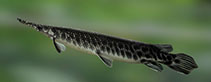
Large size and broad, short snout. Light dorsal stripe. Dark olivaceous brown above and white to yellowish beneath. Dark brown blotches on all fins (Ref. 37032).
Body shape (shape guide): elongated.
Facultative air-breathing (Ref. 126274); Adults inhabit sluggish pools and backwaters of large rivers, swamps, bayous, and lakes. Rarely enter brackish and marine waters (Ref. 5723). They feed on blue crabs, turtles, waterfowl or other birds and small mammals (Ref. 10294). Giant of the gars (Ref. 5723). Marketed fresh (Ref. 37032).
Ciclo vital y comportamiento de apareamiento
Madurez | Reproducción | Puesta | Huevos | Fecundidad | Larva
Etnier, D.A. and W.C. Starnes, 1993. The fishes of Tennessee. The University of Tennessee Press, Knoxville, Tennessee, USA. (pls. check date). (Ref. 10294)
Situación en la Lista Roja de la UICN (Ref. 130435: Version 2025-2 (Global))
Amenaza para el ser humano
Harmless
Usos humanos
Pesquerías: escaso valor comercial; pesca deportiva: si; Acuario: Acuarios públicos
Herramientas
Informes especiales
Descargar XML
Fuentes de Internet
Estimaciones basadas en modelos
Índice de diversidad filogenética (Referencia
82804): PD
50 = 0.6426 [Uniqueness, from 0.5 = low to 2.0 = high].
Bayesian length-weight: a=0.00229 (0.00093 - 0.00562), b=3.19 (2.97 - 3.41), in cm total length, based on LWR estimates for this (Sub)family-body shape (Ref.
93245).
Nivel trófico (Referencia
69278): 4.0 ±0.67 se; based on food items.
Resiliencia (Referencia
120179): Muy bajo, población duplicada en un tiempo mínimo superior a 14 años (Preliminary K or Fecundity.).
Vulnerabilidad pesquera (Ref.
59153): Very high vulnerability (90 of 100).
🛈