Περιβάλλον: περιβάλλον / κλιματική ζώνη / εύρος βάθους / εύρος διανομής
Οικολογία
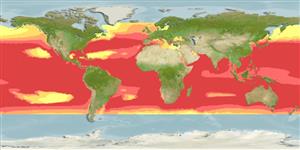
Θαλασσινό(ά) pelagic-oceanic; ωκεανόδρομο(ς) (Ref. 71039); εύρος βάθους 0 - 260 m (Ref. 9340), usually 0 - ? m (Ref. 55287). Tropical; 15°C - 30°C (Ref. 168); 63°N - 47°S, 180°W - 180°E
Cosmopolitan in tropical and warm-temperate waters. Not found in the Black Sea. Highly migratory species,
Μήκος κατά την πρώτη ωρίμανση / Μέγεθος / Βάρος / Ηλικία
Γεννητική Ωρίμανση: Lm 41.3, range 40 - 45 cm
Max length : 110 cm FL αρσενικό/απροσδιόριστο; (Ref. 89423); common length : 80.0 cm FL αρσενικό/απροσδιόριστο; (Ref. 168); μεγ. δημοσιευμένο βάρος: 34.5 kg (Ref. 168); μεγ. αναφερόμενη ηλικία: 12 έτη (Ref. 168)
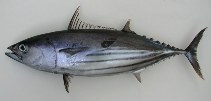
Ραχιαίες άκανθες (συνολικά) : 14 - 16; Μαλακές ραχιαίες ακτίνες (συνολικά) : 14 - 15; Εδρικές άκανθες: 0; Μαλακές εδρικές ακτίνες: 14 - 15; Σπόνδυλοι: 41. This species is distinguished by the following characters: body fusiform, elongate and rounded; teeth small and conical, in a single series; gill rakers on first gill arch numerous, 53-63; D1 XIV-XVI, dorsal fins separated by a small interspace (not larger than eye), the second followed by 7-9 finlets; anal fin followed by 7-8 finlets; pectoral fins short, with 26-27 rays; 2 flaps (interpelvic process) between pelvic fins; body scaleless except for corselet and lateral line; a strong keel on each side of caudal-fin base between 2 smaller keels. Colour of back dark purplish blue, lower sides and belly silvery, with 4-6 very conspicuous longitudinal dark bands which in live specimens may appear as discontinuous lines of dark blotches (Ref. 9684).
Body shape (shape guide): fusiform / normal; Cross section: oval.
Found in offshore waters; larvae restricted to waters with surface temperatures of 15°C to 30°C (Ref. 6390). Exhibit a strong tendency to school in surface waters with birds, drifting objects, sharks, whales and may show a characteristic behavior like jumping, feeding, foaming, etc. Feed on fishes, crustaceans, cephalopods and mollusks; cannibalism is common. Spawn throughout the year in the tropics, eggs released in several portions (Ref. 35388). Eggs and larvae are pelagic (Ref. 6769). Preyed upon by large pelagic fishes (Ref. 6885). Also taken by trolling on light tackle using plugs, spoons, feathers, or strip bait (Ref. 9684). Marketed fresh, frozen or canned (Ref. 9340, 9684 ); also dried-salted and smoked (Ref. 9987).
In tropical waters, reproductively active female skipjack tuna spawn almost daily.
Collette, B.B. and C.E. Nauen, 1983. FAO Species Catalogue. Vol. 2. Scombrids of the world. An annotated and illustrated catalogue of tunas, mackerels, bonitos and related species known to date. Rome: FAO. FAO Fish. Synop. 125(2):137 p. (Ref. 168)
Κατάσταση Κόκκινου Καταλόγου IUCN (Ref. 130435: Version 2025-2 (Global))
Απειλή για τον άνθρωπο
Reports of ciguatera poisoning (Ref. 4690)
Ανθρώπινες χρήσεις
αλιεία: πολύ εμπορικό; αλιεία αναψυχής: ναί
Εργαλεία
Ειδικές εκθέσεις
Λήψη XML
Διαδικτυακές πηγές
Εκτιμήσεις βάσει μοντέλων
Προτιμώμενη θερμοκρασία (Αναφ.
123201): 13.3 - 29, mean 26.2 °C (based on 8934 cells).
Δείκτης φυλογενετικής ποικιλότητας (Αναφ.
82804): PD
50 = 1.0000 [Uniqueness, from 0.5 = low to 2.0 = high].
Bayesian length-weight: a=0.01072 (0.00957 - 0.01200), b=3.10 (3.07 - 3.13), in cm total length, based on LWR estimates for this species (Ref.
93245).
Τροφικό Επίπεδο (Αναφ.
69278): 4.4 ±0.5 se; based on diet studies.
Generation time: 2.1 (1.8 - 2.4) years. Estimated as median ln(3)/K based on 57
growth studies.
Ελαστικότητα (Αναφ.
120179): Μεσαίο(α), ελάχιστος χρόνος για διπλασιασμό πληθυσμού 1,4 - 4,4 έτη (K=0.50; tm=2-3; tmax=12).
Prior r = 0.52, 95% CL = 0.35 - 0.79, Based on 9 full stock assessments.
Ευπάθεια στην αλιεία (Ref.
59153): Moderate vulnerability (38 of 100).
🛈
Ευπάθεια στο κλίμα (Ref.
125649): Moderate vulnerability (41 of 100).
🛈
Θρεπτικά συστατικά (Ref.
124155): Calcium = 155 [39, 307] mg/100g; Iron = 2.27 [0.81, 7.03] mg/100g; Protein = 22.3 [20.8, 23.6] %; Omega3 = 0.45 [0.22, 1.05] g/100g; Selenium = 87.4 [31.2, 237.6] μg/100g; VitaminA = 6.64 [1.25, 40.76] μg/100g; Zinc = 1.54 [0.37, 3.23] mg/100g (wet weight); based on
nutrient studies.