>
Characiformes (Characins) >
Acestrorhamphidae (American tetras) > Megalamphodinae
Etymology: Petitella: French, petit = small, diminituve (Ref. 45335).
Eponymy: Professor Georges Jean-Jacques Petit (1892–1973) was a French marine biologist at the Muséum National d’Histoire Naturelle. [...] Georgette Géry was the wife of the author Dr Jacques Géry (1917–2007) (q.v.). Although the original text was silent, the author later revealed that this was the lady honoured. (Also see Georgia) (Ref. 128868), visit book page.
More on authors: Géry & Boutière.
Taxonomic Remarks
See Géry & Mahnert (1986) for remarks on taxonomy and distribution.
Περιβάλλον: περιβάλλον / κλιματική ζώνη / εύρος βάθους / εύρος διανομής
Οικολογία
; Γλυκού νερού Πελαγικό(ά); pH range: 5.5 - 7.0; dH range: ? - 12. Tropical; 22°C - 26°C (Ref. 1672)
South America: upper Amazon River basin in Peru; Purus, Negro, and Madeira River basins.
Μέγεθος / Βάρος / Ηλικία
Γεννητική Ωρίμανση: Lm ? range ? - ? cm
Max length : 3.9 cm SL αρσενικό/απροσδιόριστο; (Ref. 38376)
Σύντομη περιγραφή
Κλείδες προσδιορισμού | Μορφολογία | Μορφομετρία
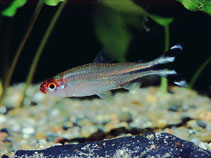
This species is distinguished from its congeners by the following characters: maxillary long and wide (vs. very short and round in bleheri and short in rhodostoma); premaxillary teeth in a single row (vs. two in bleheri, rhodostoma); dentary with 9-11 teeth with 5 cuspids (vs. 6, with 6-7 cuspids, followed by 1 or 2 tricuspidate ones in bleheri, and 5-6 with 5 cuspids, usually followed by 4 conical teeth in rhodostoma); black spot on lower posterior border of caudal peduncle absent (vs. present in bleheri, rhodostoma) (Ref. 127081)
Cross section: compressed.
Feeds on worms, small crustaceans and plant matter (Ref. 7020). Aquarium keeping: in groups of 5 or more individuals; minimum aquarium size 80 cm (Ref. 51539).
Κύκλος ζωής και συμπεριφορά ζευγαρώματος
Γεννητική Ωρίμανση | Αναπαραγωγή | Γεννοβολία | Αβγά | Γονιμότητα | Προνύμφες
Lima, F.C.T., L.R. Malabarba, P.A. Buckup, J.F. Pezzi da Silva, R.P. Vari, A. Harold, R. Benine, O.T. Oyakawa, C.S. Pavanelli, N.A. Menezes, C.A.S. Lucena, M.C.S.L. Malabarba, Z.M.S. Lucena, R.E. Reis, F. Langeani, C. Moreira et al. …, 2003. Genera Incertae Sedis in Characidae. p. 106-168. In R.E. Reis, S.O. Kullander and C.J. Ferraris, Jr. (eds.) Checklist of the Freshwater Fishes of South and Central America. Porto Alegre: EDIPUCRS, Brasil. (Ref. 38376)
Κατάσταση Κόκκινου Καταλόγου IUCN (Ref. 130435: Version 2025-2 (Global))
Απειλή για τον άνθρωπο
Harmless
Ανθρώπινες χρήσεις
αλιεία: πολύ εμπορικό; Ενυδρείο: πολύ εμπορικό
Εργαλεία
Ειδικές εκθέσεις
Λήψη XML
Διαδικτυακές πηγές
Εκτιμήσεις βάσει μοντέλων
Δείκτης φυλογενετικής ποικιλότητας (Αναφ.
82804): PD
50 = 0.6250 [Uniqueness, from 0.5 = low to 2.0 = high].
Bayesian length-weight: a=0.01122 (0.00447 - 0.02817), b=3.07 (2.86 - 3.28), in cm total length, based on LWR estimates for this (Sub)family-body shape (Ref.
93245).
Τροφικό Επίπεδο (Αναφ.
69278): 3.0 ±0.32 se; based on food items.
Ελαστικότητα (Αναφ.
120179): Υψηλό, ελάχιστος χρόνος για διπλασιασμό πληθυσμού < 15 μήνες (Preliminary K or Fecundity.).
Ευπάθεια στην αλιεία (Ref.
59153): Low vulnerability (10 of 100).
🛈