>
Eupercaria/misc (Various families in series Eupercaria) >
Labridae (Wrasses) > Hypsigenyinae
Etymology: Bodianus: Bodianus after Bodiano or Pudiano, from the Portuguese pudor, meaning modesty (Jordan & Evermann, 1896); rufus: Name from a Latin adjective meaning 'red' or 'reddish', apparently in reference to the overall reddish yellow coloration of some large individuals of this species. Believed to have been based on Catesby’s (1743) colour figure of this species referred to in Linnaeus’ original description of Labrus rufus, however, the initial-phase adult of B. insularis is also completely red (Ref. 75973).
More on author: Linnaeus.
Entorno: milieu / zona climática / rango de profundidad / gama de distribución
Ecología
marino asociado a arrecife; rango de profundidad 1 - 70 m (Ref. 9710), usually 3 - 70 m (Ref. 27115). Tropical; 22°C - 28°C (Ref. 27115); 33°N - 26°S, 98°W - 34°W
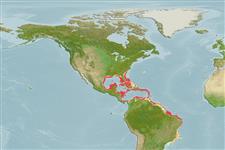
Western Atlantic: Bermuda, southern Florida (USA) and throughout the Gulf of Mexico and Caribbean Sea to southern Brazil.
Tamaño / Peso / Edad
Madurez: Lm ? range ? - ? cm
Max length : 40.0 cm TL macho / no sexado; (Ref. 9626); common length : 28.0 cm TL macho / no sexado; (Ref. 3726); peso máximo publicado: 1.0 kg (Ref. 40637)
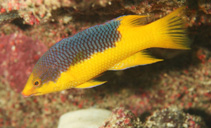
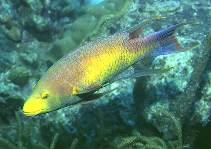
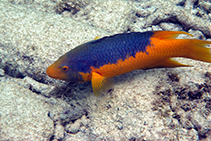
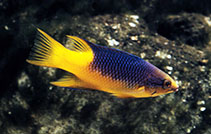
Espinas dorsales (total) : 12; Radios blandos dorsales (total) : 9 - 11; Espinas anales: 3; Radios blandos anales: 11 - 13. Head, upper front part of body, and front of dorsal fin blue if from shallow water, red if from deep; rest of body and tail yellow. Dorsal, anal, and pelvic fins mostly blue or red-yellow at rear (Ref. 26938).
Body shape (shape guide): fusiform / normal.
Adults inhabit rocky or coral reefs (Ref. 9710). Feed on brittle stars, crustaceans, mollusks, and sea urchins (Ref. 9710). Juveniles actively pick parasites from larger fishes (Ref. 5521). A protogynous hermaphrodite (Ref. ). Oviparous, distinct pairing during breeding (Ref. 205). May hybridize with spotfin hogfish, B. pulchellus (Ref. 40096). Marketed fresh (Ref. 3726). Maximum depth reported from Ref. 27115.
Ciclo vital y comportamiento de apareamiento
Madurez | Reproducción | Puesta | Huevos | Fecundidad | Larva
Oviparous (Ref. 205). Forms permanent harem groups composed of a single male and several smaller females (Ref. 55398). Monandric species (Ref. 55398). Sex reversal is completed in 7-10 days (Ref. 34185, 34247). Length at sex change = 17.28 cm TL (Ref. 55398). Spawning occurs at dusk (Ref. 55398).
Robins, C.R. and G.C. Ray, 1986. A field guide to Atlantic coast fishes of North America. Houghton Mifflin Company, Boston, U.S.A. 354 p. (Ref. 7251)
Situación en la Lista Roja de la UICN (Ref. 130435: Version 2025-2 (Global))
Amenaza para el ser humano
Reports of ciguatera poisoning (Ref. 30911)
Usos humanos
Pesquerías: escaso valor comercial; pesca deportiva: si; Acuario: Comercial
Herramientas
Informes especiales
Descargar XML
Fuentes de Internet
Estimaciones basadas en modelos
Temperatura preferida (Referencia
123201): 23.5 - 28, mean 26.7 °C (based on 620 cells).
Índice de diversidad filogenética (Referencia
82804): PD
50 = 0.5000 [Uniqueness, from 0.5 = low to 2.0 = high].
Bayesian length-weight: a=0.01023 (0.00601 - 0.01743), b=3.10 (2.95 - 3.25), in cm total length, based on LWR estimates for this species & Genus-body shape (Ref.
93245).
Nivel trófico (Referencia
69278): 3.7 ±0.2 se; based on diet studies.
Resiliencia (Referencia
120179): Medio, población duplicada en un tiempo mínimo de 1.4-4.4 años (Preliminary K or Fecundity.).
Vulnerabilidad pesquera (Ref.
59153): Low to moderate vulnerability (30 of 100).
🛈
Nutrientes (Ref.
124155): Calcium = 41.9 [26.0, 67.6] mg/100g; Iron = 0.542 [0.325, 0.951] mg/100g; Protein = 18.6 [15.8, 20.8] %; Omega3 = 0.146 [0.100, 0.213] g/100g; Selenium = 33.5 [21.2, 55.4] μg/100g; VitaminA = 101 [33, 355] μg/100g; Zinc = 1.23 [0.89, 1.86] mg/100g (wet weight);