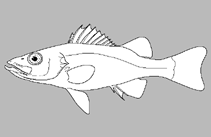
Miljö: miljö / Klimatzon / djupintervall / distributionsområde
Ekologi
; sötvatten bentopelagisk; pH range: 6.0 - 6.5; dH range: 5 - 10. Temperate; 16°C - 30°C (Ref. 2060); 25°S - 29°S
Oceania: endemic in the coastal drainages of northeast and southeast Australia, from Noosa River to Richmond River (Ref. 5259). Also in dune lakes between the Maroochy and Noosa River systems (Ref. 2906), Queensland to New South Wales, Australia.
Längd vid första mognad / Storlek / Vikt / Ålder
Könsmognad: Lm 2.9, range 2 - 2.99 cm
Max length : 7.5 cm SL hane/ej könsbestämd; (Ref. 7276); common length : 4.0 cm SL hane/ej könsbestämd; (Ref. 44894)
Inhabits ponds, dune lakes and creeks, usually among aquatic weeds (Ref. 6398). Lives in swamps with prolific sedge growth, gently flowing streams and dune lakes in areas of coastal heathland (wallum). Water is often darkly tannin-stained and acidic (pH 5.4-6.5) with temperature range from 12° to 28°C (Ref. 44894). Feeds primarily on aquatic insects and their larvae (Ref. 5259). Also consumes microcrustaceans and algae. Breeding season extends from October to May, when water temperatures rise above 20°C. The breeding habits and biology are similar to other nannopercids, but this species takes only 4-5 months to attain sexual maturity (Ref. 44894). Aquarium conditions: pH=7.2, H=8, 26°C water temperature, egg layer, plant and rock cover, peaceful community fish (Ref. 6398).
During the breading season, N. oxleyana displays sexual dichromatism, with males showing more intense changes (Ref. 74347). Males display a darkening of the dorsal, anal and pelvic fins and red colouration of the body and caudal fin (Ref. 74352). Serial spawner (Ref. 74347).
Paxton, J.R., D.F. Hoese, G.R. Allen and J.E. Hanley, 1989. Pisces. Petromyzontidae to Carangidae. Zoological Catalogue of Australia, Vol. 7. Australian Government Publishing Service, Canberra, 665 p. (Ref. 7300)
Status på IUCN:s rödlista (Ref. 130435: Version 2025-2 (Global))
Hot mot människor
Harmless
Mänskliga användningsområden
Fiskeri: saknar intresse; Akvarium: Kommersiell
Verktyg
Särskilda rapporter
Ladda ner XML
Internet-källor
Uppskattningar baserade på modeller
Index för fylogenetisk mångfald (Ref.
82804): PD
50 = 0.5156 [Uniqueness, from 0.5 = low to 2.0 = high].
Bayesian length-weight: a=0.01047 (0.00397 - 0.02763), b=3.01 (2.78 - 3.24), in cm total length, based on LWR estimates for this (Sub)family-body shape (Ref.
93245).
Trofisk nivå (Ref.
69278): 3.2 ±0.40 se; based on food items.
Resiliens (Ref.
120179): Mellan, lägsta populationsfördubblingstid 1,4-4,4 år (Fec=225-270).
Sårbarhet i fisket (Ref.
59153): Low vulnerability (10 of 100).
🛈