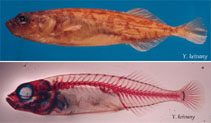
Taxonomic Remarks
Needs a taxonomic reference.
Environnement : milieu / zone climatique / profondeur / gamme de distribution
Écologie
; eau douce benthopélagique. Subtropical; 39°N - 38°N, 21°E - 23°E
Europe: Greece (lower Sperchios drainage).
Taille / Poids / Âge
Maturité: Lm ? range ? - ? cm
Max length : 4.5 cm SL mâle / non sexé; (Ref. 59043); âge max. reporté: 1.50 années (Ref. 59043)
Description synthétique
Clés d'identification | Morphologie | Morphométrie
Épines dorsales (Total) : 2 - 6. Distinguished from congeners in Europe by possessing the following unique characters: dorsal fin with 2-6 spines; and pelvic girdle absent or very reduced. Differs further from other members of the genus by having the following combination of characters: body pale olive with blackish mottling; and absence of keel on side of caudal peduncle (Ref. 59043).
Body shape (shape guide): elongated.
Adults inhabit spring-fed streams and ponds, with temperature rarely rising above 20° C and dense vegetation. Feed on small aquatic invertebrates and fish larvae. Spawn in May-June. Males build a nest and guard the eggs until hatching. Threatened due to habitat alteration and water abstraction. Attain a maximum size up to about 4.5 cm SL (Ref. 59043).
Cycle de vie et comportement reproducteur
Maturité | Reproduction | Frai | Œufs | Fécondité | Larves
Males construct a nest made of vegetal material, where females lay the eggs. They guard the eggs until hatching (Ref. 59043).
Kottelat, M. and J. Freyhof, 2007. Handbook of European freshwater fishes. Publications Kottelat, Cornol and Freyhof, Berlin. 646 pp. (Ref. 59043)
Statut dans la liste rouge de l'IUCN (Ref. 130435: Version 2025-2 (Global))
Menacé (EN) (B1ab(iii)+2ab(iii)); Date assessed: 14 September 2023
Menace pour l'homme
Harmless
Utilisations par l'homme
Pêcheries: sans intérêt
Outils
Articles particuliers
Télécharger en XML
Sources Internet
Estimations basées sur des modèles
Indice de diversité phylogénétique (Réf.
82804): PD
50 = 0.5005 [Uniqueness, from 0.5 = low to 2.0 = high].
Bayesian length-weight: a=0.00468 (0.00199 - 0.01098), b=3.04 (2.83 - 3.25), in cm total length, based on LWR estimates for this (Sub)family-body shape (Ref.
93245).
Niveau trophique (Réf.
69278): 3.3 ±0.2 se; based on size and trophs of closest relatives
Résilience (Réf.
120179): Milieu, temps minimum de doublement de population : 1,4 à 4,4 années (Assuming Fec < 1,000).
Vulnérabilité de la pêche (Ref.
59153): Low vulnerability (10 of 100).
🛈