>
Perciformes/Bembropoidei (Duckbill flatheads) >
Bembropidae (Duckbill flatheads)
Etymology: Bembrops: Greek, bembras, -ados = a kind of anchovy m+ Greek, ops = appearance (Ref. 45335); curvatura: From the Latin 'curvatura' meaning curvature, referring to the sharply curved lateral line.
Ambiente: milieu / zona climatica / distribuzione batimetrica / gamma di distribuzione
Ecologia
marino demersale; distribuzione batimetrica 100 - 280 m (Ref. 13203). Tropical
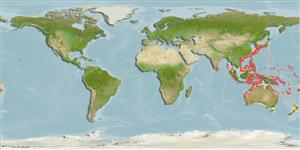
Indo-West Pacific: southern Japan, surrounding areas, Indonesia, and northwestern Australia.
Dimensione / Peso / Età
Maturità: Lm ? range ? - ? cm
Max length : 16.0 cm SL maschio/sesso non determinato; (Ref. 559)
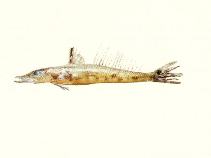
Spine dorsali (totale) : 2 - 6; Raggi dorsali molli (totale) : 13 - 23; Raggi anali molli: 15 - 29. Lateral line sloping abruptly, descent occurring primarily in anterior half (Ref 12932).
Body shape (shape guide): elongated.
Found on the shelf and shelf edge on rocky bottoms (Ref. 11230).
Ciclo vitale e comportamento di accoppiamento
Maturità | Riproduzione | Deposizione | Uova | Fecondità | Larve
Das, M.K. and J.S. Nelson, 1996. Revision of the percophid genus Bembrops (Actinopterygii: Perciformes). Bull. Mar. Sci. 59(1):9-44. (Ref. 13203)
Stato della Lista Rossa IUCN (Ref. 130435: Version 2025-2 (Global))
Minaccia per l'uomo
Harmless
Usi umani
Strumenti
Rapporti speciali
Scarica XML
Fonti Internet
Stime basate su modelli
Temperatura preferita (Fonte Biblio.
123201): 10.8 - 23.2, mean 19.1 °C (based on 157 cells).
Indice di diversità filogenetica (Fonte Biblio.
82804): PD
50 = 0.5000 [Uniqueness, from 0.5 = low to 2.0 = high].
Bayesian length-weight: a=0.00380 (0.00158 - 0.00917), b=3.11 (2.90 - 3.32), in cm total length, based on LWR estimates for this (Sub)family-body shape (Ref.
93245).
Livello trofico (Fonte Biblio.
69278): 4.0 ±0.4 se; based on size and trophs of closest relatives
Vulnerabilità della pesca (Ref.
59153): Low vulnerability (10 of 100).
🛈