>
Clupeiformes (Herrings) >
Alosidae (Shads and Sardines)
Etymology: Alosa: Latin, alausa = a fish cited by Ausonius and Latin, halec = pickle, dealing with the Greek word hals = salt; it is also the old Saxon name for shad = "alli" ; 1591 (Ref. 45335).
More on author: Bennett.
Môi trường: môi trường / vùng khí hậu / Mức độ sâu / phạm vi phân phối
Sinh thái học
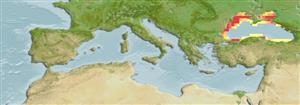
biển; nước ngọt; thuộc về nước lợ pelagic-neritic; di cư biển sông (để đẻ trứng) (Ref. 138126); mức độ sâu 3 - 90 m (Ref. 10439). Temperate; 50°N - 41°N, 27°E - 44°E
Eurasia: Black Sea and Sea of Azov ( in sea and in the Don, Danube and other rivers, as much as 567 km up the Don and as far as Kiev on the Dneiper before the dam was built). Recognized sub-species (Ref. 683): Alosa pontica pontica in the Black Sea and rivers feeding it; Alosa pontica kessleri and Alosa pontica volgensis in the Caspian Sea.
Bộ gần gũi / Khối lượng (Trọng lượng) / Tuổi
Chín muồi sinh dục: Lm ? range ? - 23.4 cm
Max length : 39.0 cm SL con đực/không giới tính; (Ref. 188); Tuổi cực đại được báo cáo: 7 các năm (Ref. 10439)
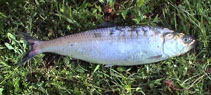
Các tia vây lưng cứng (tổng cộng) : 0; Tia cứng vây hậu môn: 0. Body fairly elongate, more `herring-like' than `shad-like'. Gill rakers rather thin, usually equal to or a little shorter than gill filaments. Teeth well developed in both jaws. Resembles A. caspia, which usually has more Gill rakers (50 to 180, much longer than gill filaments), poorly developed teeth and a deeper, `shad-like' body; A. maeotica has fewer Gill rakers (33 to 36).
Body shape (shape guide): fusiform / normal; Cross section: compressed.
Thai species is pelagic at sea, in deep water. It migrates to middle reaches of large rivers, spawning where current is strongest, close to the surface, often at 2-3 m depth in the main channel. Migrates upriver to spawn at 3 years, rarely earlier and only a few individuals spawn two seasons. It appears along the coast in March to April, enters rivers when temperatures reach about 6-9°C, between late March and late April; migration usually peaks in May. Spawning starts when temperature rises above 15°C in April to August; usually between 1 and 8 p.m. Pelagic eggs. Spent individuals return to the sea to feed. Juveniles inhabit floodplain and shallow riverine habitats, migrate to the sea or estuarine habitats during first summer; in autumn return to the sea until maturity. When at sea, it feeds on a wide variety of zooplankton (mainly crustaceans, (Crangon, Upogebia, Idothea, gammarids) and small fish (Engraulis, Clupeonella, Sprattus). Reduction of spawning sites and migration routes are caused by impoundment of main rivers. Heavy over fishing apparently reduced all populations during the first decade of the 20th century (Ref. 59043). Reaches a smaller size (30 cm SL, usually 14-18) in Don River; a smaller form reaches only 21 cm.
Eggs are pelagic (Ref. 59043).
Kottelat, M., 1997. European freshwater fishes. An heuristic checklist of the freshwater fishes of Europe (exclusive of former USSR), with an introduction for non-systematists and comments on nomenclature and conservation. Biologia, Bratislava, 52/Suppl. 5:1-271. (Ref. 13696)
Tình trạng Sách đỏ IUCN (Ref. 130435: Version 2025-2 (Global))
Mối đe dọa đối với con người
Harmless
Sử dụng của con người
Các nghề cá: buôn bán nhỏ
Các công cụ
Báo cáo đặc biệt
Tải xuống XML
Các nguồn internet
Ước tính dựa trên mô hình
Nhiệt độ ưa thích (Tài liệu tham khảo
123201): 8.6 - 14.8, mean 13.3 °C (based on 68 cells).
Chỉ số đa dạng phát sinh loài (Tài liệu tham khảo
82804): PD
50 = 0.5000 [Uniqueness, from 0.5 = low to 2.0 = high].
Bayesian length-weight: a=0.00741 (0.00616 - 0.00892), b=3.08 (3.04 - 3.12), in cm total length, based on LWR estimates for this species (Ref.
93245).
Mức dinh dưỡng (Tài liệu tham khảo
69278): 4.0 ±0.6 se; based on diet studies.
Thích nghi nhanh (Tài liệu tham khảo
120179): Trung bình, thời gian nhân đôi của chủng quần tối thiểu là 1.4 - 4.4 năm (K=0.32; tm=2; tmax=9).
Sự dễ bị tổn thương của nghề đánh cá (Ref.
59153): Low to moderate vulnerability (35 of 100).
🛈
Sự dễ bị tổn thương của khí hậu (Ref.
125649): High to very high vulnerability (67 of 100).
🛈
Chất dinh dưỡng (Ref.
124155): Calcium = 14.6 [7.1, 77.2] mg/100g; Iron = 0.56 [0.23, 1.34] mg/100g; Protein = 19.6 [17.1, 22.4] %; Omega3 = 1.44 [0.75, 2.79] g/100g; Selenium = 9.61 [4.44, 21.22] μg/100g; VitaminA = 17.7 [4.5, 66.4] μg/100g; Zinc = 0.335 [0.208, 0.588] mg/100g (wet weight); based on
nutrient studies.