Classification / Noms
Noms communs | Synonymes | Catalog of Fishes(Genre, Espèce) | ITIS | CoL | WoRMS | Cloffa
Environnement : milieu / zone climatique / profondeur / gamme de distribution
Écologie
marin bathydémersal; profondeur 180 - 704 m (Ref. 11015). Deep-water
Indo-West Pacific: Andaman Sea to Fiji; north to Japan; south to New Caledonia.
Taille / Poids / Âge
Maturité: Lm ? range ? - ? cm
Max length : 18.0 cm SL mâle / non sexé; (Ref. 559); poids max. publié: 58.00 g (Ref. 132231)
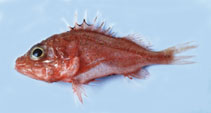
Épines dorsales (Total) : 11 - 13; Rayons mous dorsaux (Total) : 9 - 11; Épines anales: 3; Rayons mous anaux: 4 - 6. This species is distinguished by the following set of characters: scale rows between 6th dorsal-fn spine and lateral line 8-10 (usually 9); scale rows between last dorsal-fn spine and lateral line 10-13 (11); middle postorbital scale rows 3-4 (3); caudal-peduncle depth 8.2-9.6% (moderately 9.9%) of SL; interorbital width at vertical midline of eye 19.8-24.2% (22.3%) of HL, maxillary depth 14.3-16.9% (15.6%), and lower opercular spine length 28.0-33.6% (31.3%); dorsal margin of interorbital space is somewhat fattened; with nasal and parietal spines; supraocular spine is rudimentary; second lacrimal spine directed posteroventrally; tip of the lower opercular spine just short of or reaching to posterior margin of opercle (sometimes beyond margin in specimens from ca. 15.0 cm SL); jaws with short, dense conical teeth; premaxillary teeth in 3-6 irregular rows, totaling ca. 200 teeth. Colouration: head and body base color scarlet to dull red, with numerous small smudge-like or blurred black blotches above the lateral line when fresh; black distal margin on caudal fin in specimens from ca. > 10.0 cm SL; oral surface uniformly dull- to coal black in preserved specimens (uniformly pale, sometimes a few smudges on specimens up to ca. 10.0 cm SL) (Ref. 123746).
Body shape (shape guide): fusiform / normal; Cross section: compressed.
Found on the continental shelf and continental slope. Benthic (Ref. 75154). The dorsal spine contains poison glands which can inflict painful wounds (Ref. 11015).
Cycle de vie et comportement reproducteur
Maturité | Reproduction | Frai | Œufs | Fécondité | Larves
Wada, H., Y. Kai and H. Motomura, 2021. Revision of the resurrected deep-water scorpionfish genus Lythrichthys Jordan and Starks 1904 (Setarchidae), with description of two new species. Ichthyol. Res. 68(3):373-403. (Ref. 123746)
Statut dans la liste rouge de l'IUCN (Ref. 130435: Version 2025-2 (Global))
Menace pour l'homme
Venomous
Utilisations par l'homme
Pêcheries: bycatch
Outils
Articles particuliers
Télécharger en XML
Sources Internet
Estimations basées sur des modèles
Température préférée (Réf.
123201): 8.8 - 17.2, mean 11.8 °C (based on 290 cells).
Indice de diversité phylogénétique (Réf.
82804): PD
50 = 0.5317 [Uniqueness, from 0.5 = low to 2.0 = high].
Bayesian length-weight: a=0.00912 (0.00439 - 0.01895), b=3.15 (2.96 - 3.34), in cm total length, based on LWR estimates for this species & (Sub)family-body (Ref.
93245).
Niveau trophique (Réf.
69278): 3.3 ±0.4 se; based on size and trophs of closest relatives
Vulnérabilité de la pêche (Ref.
59153): Low vulnerability (12 of 100).
🛈