Klassifizierung / Names
Namen | Synonyme | Catalog of Fishes(Gattung, Arten) | ITIS | CoL | WoRMS | Cloffa
Umwelt: Milieu / Klimazone / Tiefenbereich / Verbreitungsgebiet
Ökologie
; süßwasser demersal; potamodrom (Ref. 51243); tiefenbereich 10 - ? m (Ref. 27439). Temperate; 10°C - 30°C (Ref. 2060); 19°S - 38°S
Oceania: Australia, Murray-Darling system (except in higher tributaries), Dawson-Fitzroy system of southeastern Queensland. Also in Lake Eyre and Bulloo River drainages and floodplain lakes of Western Victoria and New South Wales. Widely introduced to other coastal systems of Queensland and New South Wales.
Länge bei der ersten Reifung / Größe / Gewicht / Alter
Geschlechtsreife: Lm 45.0, range 40 - 50 cm
Max length : 76.0 cm SL Männchen/unbestimmt; (Ref. 44894); common length : 45.0 cm SL Männchen/unbestimmt; (Ref. 5259); max. veröff. Gewicht: 24.0 kg (Ref. 6390); max. veröff. Alter: 20 Jahre (Ref. 6390)
Kurzbeschreibung
Bestimmungsschlüssel | Morphologie | Morphometrie
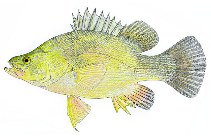
Golden perch live throughout the river systems, from the clear, fast flowing upper reaches to the turbid, slow flowing lower reaches and associated billabongs and backwaters. They favor deep pools with plenty of cover from fallen timber, rocky ledges or undercut banks (Ref. 27439, 44894). Prefer warm, slow-moving, turbid sections of streams. Also occur in flooded lakes, backwaters and impoundments. Tolerant of temperatures between 4° and 35°C and high salinity levels (up to 35 p.p.t.). Solitary species (Ref. 44894). Their diet is dominated by yabbies (Cherax destructor), and a variety of fish species (Ref. 27439). Juveniles disperse throughout the floodplain to find food and cover (Ref. 27440). They feed on abundant zooplankton on recently inundated floodplains (Ref. 6390, 44894). Adults feed on fishes, mollusks and crayfish (Ref. 44894). Spawn from early spring to late autumn. Golden perch is Australia's most migratory freshwater fish species (Ref. 6390). Spawn in flooded backwaters near the surface at night after heavy spring and summer rains. Usually a long upstream spawning migration is undertaken (movements of 2000 kilometers by tagged fish have been documented). Eggs float near the surface and hatch in 24-36 hours. Males mature after 2-3 years (20-30 centimeters), females after 4 years (40 centimeters) (Ref. 44894). They are being reared by private and government hatcheries in Victoria, New South Wales and Queensland (Ref. 27552) and the fry and fingerlings produced from these hatcheries are stocked in public waters and farm dams (Ref. 26869).
Under favourable conditions female golden perch are capable of spawning more than once a season (Ref. 27439). However, without suitable environmental cues they may fail to breed in season, with the eggs being resorbed (Ref. 27439). Spawning period is from early spring to late autumn (Ref. 6390). They commonly spawn at night (Ref. 6390).
Allen, G.R., 1989. Freshwater fishes of Australia. T.F.H. Publications, Inc., Neptune City, New Jersey. (Ref. 5259)
IUCN Rote Liste Status (Ref. 130435: Version 2025-2 (Global))
Bedrohung für Menschen
Harmless
Nutzung durch Menschen
Fischereien: kommerziell; Aquakultur: kommerziell; Sportfisch: ja
Tools
Zusatzinformationen
Download XML
Internet Quellen
Schätzungen auf der Grundlage von Modellen
Phylogenetischer Diversitätsindex (Ref.
82804): PD
50 = 0.7500 [Uniqueness, from 0.5 = low to 2.0 = high].
Bayesian length-weight: a=0.01738 (0.00677 - 0.04463), b=3.06 (2.83 - 3.29), in cm total length, based on LWR estimates for this (Sub)family-body shape (Ref.
93245).
Trophische Ebene (Ref.
69278): 3.7 ±0.57 se; based on food items.
Widerstandsfähigkeit (Ref.
120179): niedrig, Verdopplung der Population dauert 4,5 - 14 Jahre. (tm=2-5; tmax=20).
Anfälligkeit der Fischerei (Ref.
59153): Moderate vulnerability (39 of 100).
🛈