>
Anguilliformes (Eels and morays) >
Nettastomatidae (Duckbill eels)
Etymology: Nettastoma: Greek, netta = duck + Greek, stoma = mouth (Ref. 45335); parviceps: From the Latin parvus meaning little and caput meaning head, referring to the slightly smaller size of the head of this species compared to that of N. melanura, the only other species of the genus known to Günther.
More on author: Günther.
Umwelt: Milieu / Klimazone / Tiefenbereich / Verbreitungsgebiet
Ökologie
seewasser benthopelagisch; tiefenbereich 60 - 1190 m (Ref. 40819). Deep-water
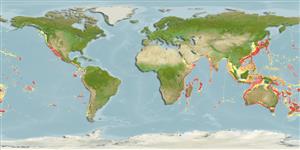
Indo-Pacific: bitemperate distribution, recorded from Japan, Hawaii, eastern Australia, and southeastern Africa. Southeast Pacific: Chile (Ref. 9068). Rare or absent in equatorial waters.
Größe / Gewicht / Alter
Geschlechtsreife: Lm ? range ? - ? cm
Max length : 82.0 cm TL Männchen/unbestimmt; (Ref. 6591)
Kurzbeschreibung
Bestimmungsschlüssel | Morphologie | Morphometrie
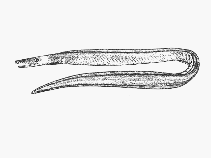
Wirbelzahl: 230. SO5 pore normally absent. Lateral line pores 49-58. Median vomerine teeth not enlarged. Posterior nostril above posterodorsal corner of eye. Other characteristics: Color gray; vertical fins black-edged; snout gray-black; iris and opercular regions silver.
Body shape (shape guide): eel-like.
Inhabits the continental slope (Ref. 7300, 75154) and shelf (Ref. 75154).
Lebenszyklus und Paarungsverhalten
Geschlechtsreife | Fortpflanzung | Ablaichen | Eier | Fruchtbarkeit | Larven
Castle, P.H.J., 1986. Nettastomatidae. p. 190-191. In M.M. Smith and P.C. Heemstra (eds.) Smiths' sea fishes. Springer-Verlag, Berlin. (Ref. 6591)
IUCN Rote Liste Status (Ref. 130435: Version 2025-2 (Global))
Bedrohung für Menschen
Harmless
Nutzung durch Menschen
Fischereien: nicht kommerziell
Tools
Zusatzinformationen
Download XML
Internet Quellen
Schätzungen auf der Grundlage von Modellen
Bevorzugte Temperatur (Ref.
123201): 7.8 - 17.5, mean 11.5 °C (based on 548 cells).
Phylogenetischer Diversitätsindex (Ref.
82804): PD
50 = 0.5312 [Uniqueness, from 0.5 = low to 2.0 = high].
Bayesian length-weight: a=0.00087 (0.00035 - 0.00219), b=2.98 (2.76 - 3.20), in cm total length, based on LWR estimates for this (Sub)family-body shape (Ref.
93245).
Trophische Ebene (Ref.
69278): 3.5 ±0.5 se; based on size and trophs of closest relatives
Widerstandsfähigkeit (Ref.
120179): niedrig, Verdopplung der Population dauert 4,5 - 14 Jahre. (Assuming tmax>10).
Anfälligkeit der Fischerei (Ref.
59153): Moderate to high vulnerability (53 of 100).
🛈