>
Siluriformes (Catfishes) >
Ariidae (Sea catfishes) > Ariinae
Etymology: Netuma: A Tamil word that means "dance".
More on author: Rüppell.
Milieu: milieu / Klimaatzone / Diepte / verspreidingsgebied
Ecologie
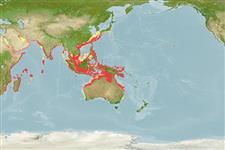
marien; zoet water; brak water demersaal; amfidroom (Ref. 51243); diepte 10 - 195 m (Ref. 12260). Subtropical; 34°N - 34°S, 32°E - 154°E
Indo-West Pacific: known with certainty from the Red Sea and the northwestern Indian Ocean. Also reported from Australia, Polynesia and Japan and rarely in the Mekong delta (Ref. 12693).
Lengte bij maturiteit / Grootte / Gewicht / Leeftijd
Maturiteit: Lm 36.3, range 33 - 45 cm
Max length : 185 cm TL mannelijk / geslacht onbekend; (Ref. 30573); common length : 70.0 cm TL mannelijk / geslacht onbekend; (Ref. 9987); max. gepubliceerd gewicht: 1.0 kg (Ref. 4883)
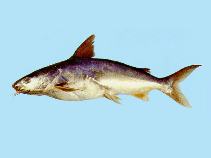
A marine species often found in estuaries, but rarely enters freshwater. Typically euryhaline (Ref. 3876). Reported to occasionally ascend into fresh water (Ref. 12693). Recorded at temperatures ranging from 26-29°C. Feeds mainly on crabs, prawns, mantis shrimps (Squilla species) but also on fishes and mollusks. An important food fish. Marketed mostly fresh; often dried.
Incubates eggs in the mouth. The fry continue to take refuge in the mouths of the male fish for the first 2 months and once they leave, the males start to eat avidly and may consume their own young.
Rainboth, W.J., 1996. Fishes of the Cambodian Mekong. FAO species identification field guide for fishery purposes. FAO, Rome, 265 p. (Ref. 12693)
Status op de Rode Lijst van het IUCN (Ref. 130435: Version 2025-2 (Global))
Gevaar voor de mens
Traumatogenic (Ref. 58010)
Gebruik door de mens
Visserij: commercieel; sportvis: ja
Tools
Speciale rapporten
Download XML
Internetbronnen
Schattingen op basis van modellen
Gewenste temperatuur (Ref.
123201): 22.1 - 28.3, mean 26.8 °C (based on 839 cells).
Fylogenetische diversiteitsindex (Ref.
82804): PD
50 = 0.6250 [Uniqueness, from 0.5 = low to 2.0 = high].
Bayesian length-weight: a=0.00776 (0.00669 - 0.00901), b=3.07 (3.03 - 3.11), in cm total length, based on LWR estimates for this species (Ref.
93245).
Trofisch niveau (Ref.
69278): 3.5 ±0.2 se; based on diet studies.
Generation time: 17.2 ( na - na) years. Estimated as median ln(3)/K based on 2
growth studies.
Weerstandsvermogen (Ref.
120179): laag, minimale populatieverdubbelingstijd 4,5-14 jaar (K=0.06-0.45; tm=2-4; tmax=19; Fec=34-88).
Prior r = 0.31, 95% CL = 0.20 - 0.46, Based on 4 data-limited stock assessments.
Kwetsbaarheid van de visserij (Ref.
59153): Moderate to high vulnerability (48 of 100).
🛈
Kwetsbaarheid voor het klimaat (Ref.
125649): High vulnerability (57 of 100).
🛈
Voedingsstoffen (Ref.
124155): Calcium = 26.3 [14.3, 64.9] mg/100g; Iron = 0.78 [0.47, 1.40] mg/100g; Protein = 18.1 [16.3, 19.9] %; Omega3 = 0.348 [0.179, 0.692] g/100g; Selenium = 46.2 [23.4, 97.4] μg/100g; VitaminA = 6.46 [2.31, 18.39] μg/100g; Zinc = 0.682 [0.451, 1.055] mg/100g (wet weight);