>
Stomiiformes (Lightfishes and dragonfishes) >
Stomiidae (Barbeled dragonfishes) > Astronesthinae
Etymology: Astronesthes: Greek, astra = ray + Greek, esthes, -es = suit, something used to wrap (Ref. 45335).
Eponymy: Sir John Richardson (1787–1865) was a Scottish naval surgeon, naturalist and Arctic explorer. [...] (Ref. 128868), visit book page.
More on author: Poey.
Umwelt: Milieu / Klimazone / Tiefenbereich / Verbreitungsgebiet
Ökologie
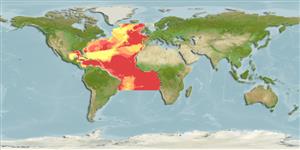
seewasser bathypelagisch; ozeanodrom (Ref. 51243); tiefenbereich 275 - 1000 m (Ref. 58426). Deep-water; 62°N - 18°S, 98°W - 14°E
Eastern Atlantic: Mauritania south to Angola; reported from central Namibia (Ref. 27121). Western Atlantic: Gulf of Mexico and Bahamas area; and across the Atlantic (20°N-10°S). One specimen known from the southwest Atlantic (25°27'S, 35°56'W).
Größe / Gewicht / Alter
Geschlechtsreife: Lm ? range ? - ? cm
Max length : 17.2 cm SL Männchen/unbestimmt; (Ref. 126117); max. veröff. Gewicht: 32.90 g (Ref. 126117)
Rückenflossenweichstrahlen (insgesamt) : 15 - 17; Afterflossenweichstrahlen: 12 - 15. Barbel without pigment, tapering to end, lacking swelling or bulb (Ref. 37473). Body moderately elongate and slender. Maxillary teeth closely spaced. Serial photophores not broken into small groups. Luminous patches present on margin of operculum. Black in color (Ref. 37039).
Body shape (shape guide): elongated.
Oceanic, usually living deeper than 500 m during the day. Smaller individuals migrate to the surface at night. Possibly feeding on crustaceans and fishes (Ref. 58426). Minimum depth from Ref. 58018.
Lebenszyklus und Paarungsverhalten
Geschlechtsreife | Fortpflanzung | Ablaichen | Eier | Fruchtbarkeit | Larven
Gibbs, R.H. Jr., 1990. Astronesthidae. p. 300-307. In J.C. Quero, J.C. Hureau, C. Karrer, A. Post and L. Saldanha (eds.) Check-list of the fishes of the eastern tropical Atlantic (CLOFETA). JNICT, Lisbon; SEI, Paris and UNESCO, Paris. Vol. 1. (Ref. 4465)
IUCN Rote Liste Status (Ref. 130435: Version 2025-2 (Global))
Bedrohung für Menschen
Harmless
Nutzung durch Menschen
Tools
Zusatzinformationen
Download XML
Internet Quellen
Schätzungen auf der Grundlage von Modellen
Bevorzugte Temperatur (Ref.
123201): 7.1 - 9.4, mean 8.6 °C (based on 35 cells).
Phylogenetischer Diversitätsindex (Ref.
82804): PD
50 = 0.5000 [Uniqueness, from 0.5 = low to 2.0 = high].
Bayesian length-weight: a=0.00437 (0.00217 - 0.00879), b=3.08 (2.89 - 3.27), in cm total length, based on LWR estimates for this species & (Sub)family-body (Ref.
93245).
Trophische Ebene (Ref.
69278): 3.9 ±0.64 se; based on food items.
Widerstandsfähigkeit (Ref.
120179): mittel, Verdopplung der Population dauert 1,4 - 4,4 Jahre. (Assuming tmax>3).
Anfälligkeit der Fischerei (Ref.
59153): Low vulnerability (11 of 100).
🛈