Milieu: milieu / Klimaatzone / Diepte / verspreidingsgebied
Ecologie
; zoet water; brak water pelagic-neritic; pH range: 7.0 - 7.5; dH range: 20 - ?; standvastig (Ref. 126106); diepte 0 - 2 m (Ref. 58302). Tropical; 22°C - 28°C (Ref. 1672); 38°N - 5°N
Asia: Sri Lanka and India eastward to the Mekong.
Grootte / Gewicht / Leeftijd
Maturiteit: Lm ? range ? - ? cm
Max length : 40.0 cm TL mannelijk / geslacht onbekend; (Ref. 4833); common length : 30.0 cm TL mannelijk / geslacht onbekend; (Ref. 4833)
Korte beschrijving
Determinatiesleutels | Morfologie | Morfometrie
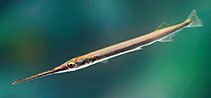
Dorsale stekels (totaal) : 0; Dorsale zachte stralen (totaal) : 15 - 18; Anale stekels: 0; Anale zachte stralen: 16 - 18. Body very elongate and slightly compressed. Dorsal fin inserted usually anterior to a vertical through the origin of the anal fin. Green-silvery dorsally, grading to whitish below. A silvery band with a dark margin run along the side; a series of four or five blotches (absent in young specimens) on sides between the pectoral and anal fins. Dorsal and anal fins with dark edges.
Body shape (shape guide): elongated.
Adults occur primarily in rivers (Ref. 4833); also in ponds, canals, beels, and inundated fields (Ref. 1479). Often found in slow-flowing pools in rivers with a rock or sand substrate (Ref. 6028). They inhabit large and medium-sized rivers with adults occurring in areas that lack floating vegetation (Ref. 12693). A solitary species that swims in midwater, usually against the current, and is capable of bursts of speed, especially when in pursuit of its prey. Observed to feed exclusively on crustaceans in the wild; but take live fish only when in an aquarium (Ref. 6028). Also feeds on small fishes and insects (Ref. 12693). Oviparous (Ref. 205). Eggs may be found attached to objects in the water by tendrils on the egg's surface (Ref. 205). This fish is capable of nipping the fingers or killing a person by leaping at them at great speed (Ref. 6028; Kullander (pers. comm., 2001), however, suggests that the "killing a person" statement may be exaggerated). Marketed fresh (Ref. 12693).
Levenscyclus en paargedrag
Maturiteit | Voortplanting | Paaien | Eieren | Fecunditeit | Larven
Male pursues a slow-moving female and upon catching up with the female, will begin shuddering from side to side while the pair is oriented parallel to each other; the pair positions themselves close to submerged vegetation; male assumes a slight head-down position , with his anal fin curled under the female's vent; the pair begins trembling until a single large egg is released; each female produces about a dozen eggs per day; eggs hatch in about a week; no parental care (Ref. 44091).
Talwar, P.K. and A.G. Jhingran, 1991. Inland fishes of India and adjacent countries. Volume 2. A.A. Balkema, Rotterdam, i-xxii + 543-1158, 1 pl. (Ref. 4833)
Status op de Rode Lijst van het IUCN (Ref. 130435: Version 2025-2 (Global))
Gevaar voor de mens
Traumatogenic (Ref. 6028)
Gebruik door de mens
Visserij: van minder commercieel belang; Aquarium: Potentieel
Tools
Speciale rapporten
Download XML
Internetbronnen
Schattingen op basis van modellen
Fylogenetische diversiteitsindex (Ref.
82804): PD
50 = 0.7500 [Uniqueness, from 0.5 = low to 2.0 = high].
Bayesian length-weight: a=0.00115 (0.00094 - 0.00140), b=3.12 (3.06 - 3.18), in cm total length, based on LWR estimates for this species (Ref.
93245).
Trofisch niveau (Ref.
69278): 3.9 ±0.62 se; based on food items.
Weerstandsvermogen (Ref.
120179): Hoog, minimale populatieverdubbelingstijd minder dan 15 maanden (Preliminary K or Fecundity.).
Kwetsbaarheid van de visserij (Ref.
59153): Low to moderate vulnerability (30 of 100).
🛈
Voedingsstoffen (Ref.
124155): Calcium = 284 [95, 708] mg/100g; Iron = 0.8 [0.4, 1.6] mg/100g; Protein = 16.7 [15.3, 18.3] %; Omega3 = 0.205 [0.082, 0.602] g/100g; Selenium = 36.6 [14.8, 85.7] μg/100g; VitaminA = 43.9 [18.2, 104.0] μg/100g; Zinc = 1.72 [1.04, 2.47] mg/100g (wet weight); based on
nutrient studies.