Elasmobranquios (tiburones y rayas) (sharks and rays) >
Rajiformes (Skates and rays) >
Arhynchobatidae (Softnose skates)
Etymology: Bathyraja: Greek, bathys = deep + Latin, raja, -ae = a ray (Raja sp) (Ref. 45335).
Eponymy: Dr Sir Andrew Smith (1797–1872) was a Scotsman who joined the Army Medical Service (1819) after graduating from Edinburgh University. [...] (Ref. 128868), visit book page.
More on authors: Müller & Henle.
Entorno: milieu / zona climática / rango de profundidad / gama de distribución
Ecología
marino batidemersal; rango de profundidad 440 - 1020 m (Ref. 5578). Deep-water; - 40°S
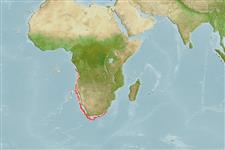
Southeast Atlantic: off central Namibia to Agulhas Bank, South Africa.
Tamaño / Peso / Edad
Madurez: Lm ? range ? - ? cm
Max length : 120 cm TL macho / no sexado; (Ref. 5578)
Descripción breve
Claves de identificación | Morfología | Morfometría
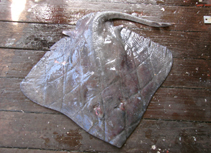
A large softnose skate with a broadly triangular, bluntly pointed snout and an angular pectoral disc; tail shorter than body and with a single row of large thorns; upper disc of young with thorns but these are lost with growth (Ref. 5578). Dorsal surface greyish and may have white spots, ventral surface white with dark grey blotches around gill slits, vent and along ventral surface of tail (Ref. 5578). Tail with no color bands (Ref. 5578).
Body shape (shape guide): other.
Found on the upper continental slope (Ref. 27121). A bottom-predator that feeds on bony fishes including hake, jacopever, barracudina and dragonet; also squid, octopus, crabs and prawns (Ref. 5578). Oviparous (Ref. 50449). Eggs have horn-like projections on the shell (Ref. 205). Sometimes caught by hake trawlers (Ref. 5578).
Ciclo vital y comportamiento de apareamiento
Madurez | Reproducción | Puesta | Huevos | Fecundidad | Larva
Oviparous, paired eggs are laid. Embryos feed solely on yolk (Ref. 50449). Eggs have horn-like projections on the shell (Ref. 205).
McEachran, J.D. and K.A. Dunn, 1998. Phylogenetic analysis of skates, a morphologically conservative clade of elasmobranchs (Chondrichthyes: Rajidae). Copeia 1998(2):271-290. (Ref. 27314)
Situación en la Lista Roja de la UICN (Ref. 130435: Version 2025-2 (Global))
Amenaza para el ser humano
Harmless
Usos humanos
Pesquerías: bycatch
Herramientas
Informes especiales
Descargar XML
Fuentes de Internet
Estimaciones basadas en modelos
Temperatura preferida (Referencia
123201): 4.6 - 11.8, mean 5.4 °C (based on 13 cells).
Índice de diversidad filogenética (Referencia
82804): PD
50 = 0.5000 [Uniqueness, from 0.5 = low to 2.0 = high].
Bayesian length-weight: a=0.00562 (0.00296 - 0.01067), b=3.13 (2.97 - 3.29), in cm total length, based on LWR estimates for this Genus-body shape (Ref.
93245).
Nivel trófico (Referencia
69278): 4.3 ±0.67 se; based on food items.
Resiliencia (Referencia
120179): Bajo, población duplicada en un tiempo mínimo de 4.5-14 años (Fec assumed to be <100).
Vulnerabilidad pesquera (Ref.
59153): High to very high vulnerability (72 of 100).
🛈