>
Siluriformes (Catfishes) >
Bagridae (Bagrid catfishes)
Etymology: Sperata: After Mr. M.A. Sperat.
Eponymy: Maria Adolfine Sperat was the late mother-in-law of author Maximilian Holly (q.v.) who had supported Holly’s studies with ‘great understanding’. (Also see Maria) (Ref. 128868), visit book page.
Ambiente: milieu / zona climática / intervalo de profundidade / gama de distribuição
Ecologia
; Água doce; estuarina demersal; potamódromo (Ref. 51243). Tropical; 39°N - 8°N
Asia: Afghanistan, Pakistan, India, Nepal and Bangladesh (Ref. 4833). Reported from Thailand (Ref. 37773) and Yunnan, China (Ref. 84139).
Tamanho / Peso / Idade
Maturidade: Lm ? range ? - ? cm
Max length : 150 cm TL macho/indeterminado; (Ref. 4833); common length : 40.0 cm TL macho/indeterminado; (Ref. 4833)
Descrição breve
Chaves de identificação | Morfologia | Morfometria
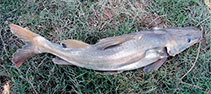
Espinhos dorsais (total) : 1; Raios dorsais moles (total) : 7; Espinhos anais: 0; Raios anais moles: 11 - 12. Body elongate and compressed; snout broad and spatulate. Barbels extend posteriorly to pelvic fins or beyond to anal fin. Dorsal spine weakly serrated on its posterior edge; adipose fin base short, about as long as the rayed dorsal fin base. Color is brownish-gray on back, silvery on flanks and belly. A dark well-defined spot is on the adipose dorsal fin.
Body shape (shape guide): elongated; Cross section: oval.
Found in rivers, canals, beels, ditches, inundated fields and other freshwater areas. Adults fight well and provide good sport. Carnivore. Breeding occurs before the commencement of monsoons. Oviparous, distinct pairing possibly like other members of the same genus (Ref. 205).
Ciclo de vida e comportamento de acasalamento
Maturidade | Reprodução | Desova | Ovos | Fecundidade | Larvas
Talwar, P.K. and A.G. Jhingran, 1991. Inland fishes of India and adjacent countries. Volume 2. A.A. Balkema, Rotterdam, i-xxii + 543-1158, 1 pl. (Ref. 4833)
Categoria na Lista Vermelha da IUCN (Ref. 130435: Version 2025-2 (Global))
Ameaça para o homem
Harmless
Utilização humana
Pescarias: espécies comerciais; Aquacultura: uso futuro provável; peixe desportivo: sim
Ferramentas
Relatórios especiais
Descarregue XML
Fontes da internet
Estimativas baseadas em modelos
Índice de diversidade filogenética (Ref.
82804): PD
50 = 0.5625 [Uniqueness, from 0.5 = low to 2.0 = high].
Bayesian length-weight: a=0.00776 (0.00650 - 0.00926), b=2.91 (2.86 - 2.96), in cm total length, based on LWR estimates for this species (Ref.
93245).
Nível Trófico (Ref.
69278): 3.8 ±0.1 se; based on size and trophs of closest relatives
Resiliência (Ref.
120179): Elevada, tempo mínimo de duplicação da população menor que 15 meses (Fec = 20,064).
Vulnerabilidade da pesca (Ref.
59153): Very high vulnerability (90 of 100).
🛈
Nutrientes (Ref.
124155): Calcium = 82.3 [25.9, 180.8] mg/100g; Iron = 0.933 [0.496, 1.681] mg/100g; Protein = 16.8 [15.2, 18.4] %; Omega3 = 0.116 [0.056, 0.243] g/100g; Selenium = 84.6 [43.7, 171.3] μg/100g; VitaminA = 12.4 [3.3, 41.2] μg/100g; Zinc = 0.333 [0.211, 0.550] mg/100g (wet weight); based on
nutrient studies.