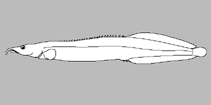
Περιβάλλον: περιβάλλον / κλιματική ζώνη / εύρος βάθους / εύρος διανομής
Οικολογία
; Γλυκού νερού βενθοπελαγικό; ποταμόδρομος (Ref. 51243). Tropical
Africa: coastal river basins from the Cess/Nipoué as western distribution border and certainly up to the Volta and questionably up to the Niger River basin as eastern distribution border (Ref. 57415).
Μήκος κατά την πρώτη ωρίμανση / Μέγεθος / Βάρος / Ηλικία
Γεννητική Ωρίμανση: Lm 15.0 range ? - ? cm
Max length : 42.2 cm SL αρσενικό/απροσδιόριστο; (Ref. 57415)
Ραχιαίες άκανθες (συνολικά) : 28 - 32; Μαλακές ραχιαίες ακτίνες (συνολικά) : 82 - 104; Μαλακές εδρικές ακτίνες: 75 - 94; Σπόνδυλοι: 91 - 98. Diagnosis: no pre-opercular spines; 27+1 up to 31+1 (median 29+1) dorsal spines; distance from anterior border of snout to last externally visible dorsal spine 49.7-57.6% SL (m=54.2), increasing with size; distance from posterior edge of pectoral fin to anterior origin of 1st dorsal spine between (-21.7) and 0.0% HL [m = -11.8]; pre-orbital spine as good as always present; snout with a more pointed appearance; origin of 1st dorsal spine situated anterior to, or below, posterior edge of pectoral fin; distance from anterior border of snout to last externally visible dorsal spine 50.0-57.6% SL (m=54.1), shorter than distance from anterior border of snout to last externally visible anal spine, 54.2-62% SL (m=58.3), both decreasing in percentages with increasing size; post-anal length 43.5-51.0% SL (m=46.3) increasing with size, shorter than pre-anal length, 48.3-55.1% SL (m=52.5) and decreasing with size, becoming equal to latter with increasing size; 9-12 caudal fin rays; 4-6 predorsal vertebrae; 35-40 abdominal vertebrae; (+4)-(+5) in-between vertebrae; 53-60 caudal vertebrae (Ref. 57415).
Coloration: light brown overall background colour; lateral sides characterized by a more or less pronounced dark brown battlement pattern, which forms a well delimited edge between dark lateral sides and lighter colour dorsal sides and dorsal midline; nevertheless, dorsal midline often with a series of dark brown saddle-like blotches; ventral side of head, belly and abdomen white, yellowish of colour but not so well delimited from lower sides; lower sides with irregularly shaped, white, yellowish spots; background colour of dorsal caudal and anal fins white, transparent, mottled scarcely with small, round, brown spots; dorsal and anal fin base with a series of dark brown, round spots partially situated, respectively, on dorsal and ventral part of tail; often those spots not independent but connected with dark brown-coloured tail and can even be interpreted as an enlargement of tail colour pattern on basal part of fins; on the more distal part of dorsal and anal fins additional small dark brown spots can be observed; pectoral fins white, yellowish of overall background colour with small light brown spots and a brown base; colour pattern changes with size, especially darkening of unpaired fins; nevertheless, outermost margin of dorsal, caudal and anal fins always remains white; in addition, small dark brown spots situated on more distal part of median fins, gradually with increasing size, form a continuous broad, black band on these fins; on anal fin this band is often connected with ventral side of tail due to an enlargement of the spots situated on base of fin resulting in a series of yellowish, white spots on base of anal fin; on dorsal fin both remain separate; upper edge of lateral dark brown band with its battlement pattern becomes less contrasted or may even disappear (Ref. 57415).
Body shape (shape guide): eel-like.
Maximum reported TL was 443mm (Ref. 57415).
Κύκλος ζωής και συμπεριφορά ζευγαρώματος
Γεννητική Ωρίμανση | Αναπαραγωγή | Γεννοβολία | Αβγά | Γονιμότητα | Προνύμφες
Vreven, E.J., 2003. Mastacembelidae. p. 708-737 In C. Lévêque, D. Paugy and G.G. Teugels (eds.) Faune des poissons d'eaux douce et saumâtres de l'Afrique de l'Ouest, Tome 2. Coll. Faune et Flore tropicales 40. Musée Royal de l'Afrique Centrale, Tervuren, Belgique, Museum National d'Histoire Naturalle, Paris, France and Institut de Recherche pour le Développement, Paris, France. 815 p. (Ref. 57415)
Κατάσταση Κόκκινου Καταλόγου IUCN (Ref. 130435: Version 2025-2 (Global))
Απειλή για τον άνθρωπο
Harmless
Ανθρώπινες χρήσεις
Εργαλεία
Ειδικές εκθέσεις
Λήψη XML
Διαδικτυακές πηγές
Εκτιμήσεις βάσει μοντέλων
Δείκτης φυλογενετικής ποικιλότητας (Αναφ.
82804): PD
50 = 0.5000 [Uniqueness, from 0.5 = low to 2.0 = high].
Bayesian length-weight: a=0.00363 (0.00211 - 0.00624), b=2.96 (2.80 - 3.12), in cm total length, based on LWR estimates for this species & (Sub)family-body (Ref.
93245).
Τροφικό Επίπεδο (Αναφ.
69278): 3.9 ±0.6 se; based on size and trophs of closest relatives
Ελαστικότητα (Αναφ.
120179): Μεσαίο(α), ελάχιστος χρόνος για διπλασιασμό πληθυσμού 1,4 - 4,4 έτη (Preliminary K or Fecundity.).
Ευπάθεια στην αλιεία (Ref.
59153): Moderate vulnerability (41 of 100).
🛈