Milieu: milieu / Klimaatzone / Diepte / verspreidingsgebied
Ecologie
; zoet water benthopelagisch. Tropical
Africa: widespread throughout the Congo River basin in Democratic Republic of the Congo (Ref. 2970), Cameroon (Ref. 51193), Angola (Ref. 11970, 120641), Central African Republic (Ref. 45441) and Zambia (Ref. 95585). Also reported from the lower Chari-Logone system (Lake Chad basin) in Chad (Ref. 57415).
Grootte / Gewicht / Leeftijd
Maturiteit: Lm ? range ? - ? cm
Max length : 43.5 cm SL mannelijk / geslacht onbekend; (Ref. 84205)
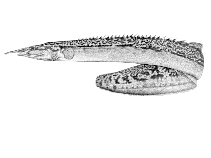
Dorsale stekels (totaal) : 29; Dorsale zachte stralen (totaal) : 84; Anale zachte stralen: 80; Wervels: 86 - 88. Diagnosis: 2 strong pre-opercular spines; distance from anterior border of snout to last externally visible dorsal spine relatively long, 57.2% SL; origin of soft dorsal fin about at same height as origin of soft anal fin; postorbital length relatively short, 55.0% HL; 28+1 dorsal spines; 1 strong pre-orbital spine; origin of 1st dorsal spine situated before posterior edge of pectoral fin, (- 2.1)% HL; distance from anterior border of snout to last, externally visible, dorsal spine 57.2% SL, comparable to distance from anterior border of snout to last, externally visible, anal spine, 57.7% SL; post-anal length 49.0% SL, shorter than pre-anal length, 50.4 % SL: 10 caudal fin rays; 6 predorsal vertebrae; 33 abdominal vertebrae; 0 in-between vertebrae; 55 caudal vertebrae (Ref. 57415).
Coloration: uniformly light brown overall background colour; dorsal midline with a series of large, dark brown squared or more X-like spots; upper sides, above lateral line or lateral midline, generally marbled with dark brown irregularly shaped spots; dark brown band originating at base of rostral appendage, passing through eye, above pectoral fin and continuing as a more or less continuous dark brown band, or as a series of large X-like spots along lateral side of body and tail; ventral side of head, belly and abdomen light brown, yellowish-white; dorsal, caudal and anal fins white of overall background colour; dorsal and anal fin base both with a series of dark brown spots partially situated on tail as well; in addition, dorsal and anal fins both with as good as no, or no, additional dark brown spots; pectoral fins white of overall background colour with no, or as good as no, dark brown spots; colour pattern changes with size, notably a general darkening of unpaired fins; in addition, spots on dorsal fin forming several, dark brown, oblique, posteriorly lowering aligned series or bars; dark brown spots on anal fin contacting dark brown band situated towards outer margin of fin resulting in a series of rounded, white spots at anal fin base; nevertheless, unpaired fins retain their white outermost margin; tendency to lose lateral series of X-like spots with increasing size; first, lower arms of X-like spots, situated below lateral line or lateral midline of body, start to fade and gradually completely disappear resulting in more uniformly light brown-coloured lower sides; further, with increasing size, upper arms of X-like spots become less well contrasted with marbled upper sides of body and tail; finally, in the largest specimens, X-like spots are as good as not, or not discernable anymore resulting in a far more uniform dark brown colour pattern of body and tail (Ref. 57415).
Body shape (shape guide): eel-like.
Levenscyclus en paargedrag
Maturiteit | Voortplanting | Paaien | Eieren | Fecunditeit | Larven
Vreven, E.J., 2003. Mastacembelidae. p. 708-737 In C. Lévêque, D. Paugy and G.G. Teugels (eds.) Faune des poissons d'eaux douce et saumâtres de l'Afrique de l'Ouest, Tome 2. Coll. Faune et Flore tropicales 40. Musée Royal de l'Afrique Centrale, Tervuren, Belgique, Museum National d'Histoire Naturalle, Paris, France and Institut de Recherche pour le Développement, Paris, France. 815 p. (Ref. 57415)
Status op de Rode Lijst van het IUCN (Ref. 130435: Version 2025-2 (Global))
Gevaar voor de mens
Harmless
Gebruik door de mens
Tools
Speciale rapporten
Download XML
Internetbronnen
Schattingen op basis van modellen
Fylogenetische diversiteitsindex (Ref.
82804): PD
50 = 0.5000 [Uniqueness, from 0.5 = low to 2.0 = high].
Bayesian length-weight: a=0.00513 (0.00265 - 0.00991), b=3.03 (2.86 - 3.20), in cm total length, based on LWR estimates for this species & (Sub)family-body (Ref.
93245).
Trofisch niveau (Ref.
69278): 3.9 ±0.6 se; based on size and trophs of closest relatives
Weerstandsvermogen (Ref.
120179): Gemiddeld, minimale populatieverdubbelingstijd 1,4-4,4 jaar (Preliminary K or Fecundity.).
Kwetsbaarheid van de visserij (Ref.
59153): Moderate vulnerability (41 of 100).
🛈