>
Gobiiformes (Gobies) >
Milyeringidae (Blind cave gudgeons)
Etymology: Typhleotris: Greek, typhlos = blind + the name of a Nile fish, eleotris (Ref. 45335); madagascariensis: Named by Petit (1933) [Ref. 94243] for the country of origin (Ref. 93144).
Milieu: milieu / Klimaatzone / Diepte / verspreidingsgebied
Ecologie
; zoet water demersaal. Tropical
Africa: Madagascar, extending from wells near Ambilahilalika, located about midway between Soalara and Efoetse in the north, southward to Nikotsy sinkhole, located just to the north of Itampolo (Ref. 93144). Its presence just north of the Linta River has to be confirmed (Ref. 93144). Also Ref. 6802, 91201.
Grootte / Gewicht / Leeftijd
Maturiteit: Lm ? range ? - ? cm
Max length : 8.0 cm SL mannelijk / geslacht onbekend; (Ref. 93144)
Korte beschrijving
Determinatiesleutels | Morfologie | Morfometrie
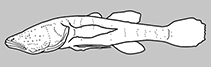
Dorsale stekels (totaal) : 5; Dorsale zachte stralen (totaal) : 8 - 9; Anale stekels: 0; Anale zachte stralen: 8; Wervels: 24 - 25. Diagnosis: This species is distinguished from congeners by the presence of scales extending fully onto head; head is more or less fully scaled, including opercle and subopercle, cheek, snout, preorbital and interorbital regions, and nape (Ref. 93144). Typhleotris madagascariensis is further distinguished from T. mararybe by the absence of pigment on the body and fins, a shorter second predorsal length (56.2-64.1% of standard length vs. 64.9-69.0% of standard length), and a more or less rounded head and snout in dorsal and lateral view vs. strongly concave/indented in orbital region; and from T. pauliani by a pelvic count of I,5 (vs. I,4 in T. pauliani) and the absence of spines in both the second dorsal and anal fins (vs. single spine present in both fins) (Ref. 93144).
Body shape (shape guide): elongated.
Blind and pigment-free obligate cave-dwelling species; restricted to subterranean habitats (caves, sinkholes, wells) within the Mahafaly Plateau karst formation, as well as isolated locations with Eocene limestone along the coastal plain below and to the west of the plateau, to the south of the large Onilahy River drainage basin (Ref. 93144). Apparently confined in underground waters (Ref. 6802). Attracted by disturbance of water surface (Ref. 94243). Feeds on crustaceans and insects found in caves (Ref. 91201).
Levenscyclus en paargedrag
Maturiteit | Voortplanting | Paaien | Eieren | Fecunditeit | Larven
Sparks, J.S. and P. Chakrabarty, 2012. Revision of the endemic Malagasy Cavefish genus Typhleotris (Teleostei: Gobiiformes: Milyeringidae), with discussion of its phylogenetic placement and description of a new species. American Museum Novitates 3764:1-28. (Ref. 93144)
Status op de Rode Lijst van het IUCN (Ref. 130435: Version 2025-2 (Global))
Gevaar voor de mens
Harmless
Gebruik door de mens
Visserij: van geen belang
Tools
Speciale rapporten
Download XML
Internetbronnen
Schattingen op basis van modellen
Fylogenetische diversiteitsindex (Ref.
82804): PD
50 = 0.6406 [Uniqueness, from 0.5 = low to 2.0 = high].
Bayesian length-weight: a=0.00389 (0.00180 - 0.00842), b=3.12 (2.94 - 3.30), in cm total length, based on all LWR estimates for this body shape (Ref.
93245).
Trofisch niveau (Ref.
69278): 3.3 ±0.4 se; based on size and trophs of closest relatives
Kwetsbaarheid van de visserij (Ref.
59153): Low vulnerability (10 of 100).
🛈