分類 / 名前
共通名の | 類義語 | Catalog of Fishes(部類, 種) | ITIS | CoL | WoRMS | Cloffa
>
Carangiformes (Jacks) >
Carangidae (Jacks and pompanos) > Caranginae
Etymology: Pseudocaranx: Greek, pseudes = false + French, carangue, the name of a Caribbean fish; 1836 (Ref. 45335).
More on authors: Bloch & Schneider.
Taxonomic Remarks
The species Pseudocaranx cheilio (Snyder, 1904) is considered as valid in Eschmeyer (CofF ver. Mar. 2011: Ref. 86697) following Randall (2007: Ref. 86689). The species Pseudocaranx georgianus (Cuvier, 1833) is considered as valid in CofF ver. May. 2011 following Smith-Vaniz & Jelks (2006: Ref. 76781), with Caranx luna Geoffroy Saint-Hilaire, 1817, Caranx platessa Cuvier, 1833, Caranx nobilis Macleay,1881, and Usacaranx archeyi Griffin, 1932 as synonyms. Caranx georgianus (now under Pseudocaranx is also a valid species.
環境:環境 / 気候帯 / 深さの範囲 / 分布範囲
生態学
海; 汽水性の 関連する礁; 深さの範囲 10 - 238 m (Ref. 58302), usually 10 - 25 m (Ref. 5288). Tropical; 40°N - 47°S
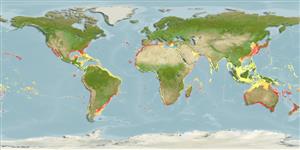
Western Atlantic: North Carolina, USA and Bermuda to southern Brazil. Eastern Atlantic: Mediterranean, Azores, Madeira, the Canary Islands, Cape Verde, Ascension and St. Helena Island. Indo-Pacific: South Africa, Japan, Hawaii (Ref. 26145), Australia, Lord Howe and Norfolk islands, New Zealand. Reported from New Caledonia (Ref. 9070).
初回成熟時の長さ / サイズ / 重さ / 年齢
成熟: Lm 34.5, range 28 - 37 cm
Max length : 122 cm TL オス/雌雄の選別がない; (Ref. 4887); common length : 40.0 cm TL オス/雌雄の選別がない; (Ref. 9258); 最大公表体重: 18.1 kg (Ref. 4887); 最大記録サイズ: 49 年 (Ref. 31614)
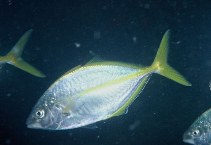
背面の脊椎 (合計) : 9; 背鰭 (合計) : 25 - 26; 肛門の骨: 3; 臀鰭: 21 - 22; 脊つい: 25. Greenish blue above, silvery white below; midside of body with yellow stripe; opercle with black spot (Ref. 3197). LL with 20-26 scutes (Ref. 6390). With maxilla the rear edge sloping slightly forward to its main axis, a large, diffuse dark blotch on the operculum, and a lateral line with 57-78 scales in the curved portion and 34-46 posterior scutes (Ref. 33616).
Body shape (shape guide): fusiform / normal.
Adults occur in bays and coastal waters, including estuaries (Ref. 9563). Juveniles usually inhabit estuaries, bays and shallow continental shelf waters, while adults form schools near the sea bed on the continental shelf (Ref. 6390). Schools are found at the surface, in mid-water and on the bottom and are often associated with reefs and rough bottom (Ref. 9072). Schools are sometimes mixed with Caranx koheru and Arripis trutta (Ref. 9072). Feed on plankton by ram-filtering and suction feeding and on bottom invertebrates (Ref. 9072, 30206). Eggs are pelagic (Ref. 4233). Cultured only in Japan. (Ref. 4931). One of the best table fish 'being indeed the salmon of St. Helena' (Ref. 5288).
ライフサイクルと交尾行動
成熟 | 繁殖 | 放精 | 卵 | 生産力 | 幼生
They are usually partial spawners, releasing eggs in small batches at intervals over a period of several weeks (Ref. 27733).
Paxton, J.R., D.F. Hoese, G.R. Allen and J.E. Hanley, 1989. Pisces. Petromyzontidae to Carangidae. Zoological Catalogue of Australia, Vol. 7. Australian Government Publishing Service, Canberra, 665 p. (Ref. 7300)
IUCNのレッドリストの状況は (Ref. 130435: Version 2025-2 (Global))
人間の用途
水産業: 商業; 水産養殖: 商業; ゲームフィッシュ: はい
用具
特記事項
XMLをダウンロードして下さい
インターネットの情報源
モデルに基づく推定値
好ましい温度 (参照
123201): 15.3 - 25.9, mean 22.3 °C (based on 362 cells).
系統多様性指数 (参照
82804): PD
50 = 0.5625 [Uniqueness, from 0.5 = low to 2.0 = high].
Bayesian length-weight: a=0.01380 (0.00852 - 0.02237), b=2.97 (2.84 - 3.10), in cm total length, based on LWR estimates for this species & (Sub)family-body (Ref.
93245).
栄養段階 (参照
69278): 3.9 ±0.6 se; based on diet studies.
回復力 (参照
120179): 低い, 4.5年~14年の倍増期間の最小個体群 (Assumed K=0.06 and tm>5; tmax=49).
Prior r = 0.42, 95% CL = 0.28 - 0.63, Based on 1 data-limited stock assessment.
漁業の脆弱性 (Ref.
59153): High to very high vulnerability (73 of 100).
🛈
気候脆弱性 (Ref.
125649): Moderate to high vulnerability (52 of 100).
🛈
栄養素 (Ref.
124155): Calcium = 23.5 [11.5, 45.7] mg/100g; Iron = 0.594 [0.313, 1.142] mg/100g; Protein = 19.6 [18.4, 20.9] %; Omega3 = 0.144 [0.086, 0.253] g/100g; Selenium = 52.3 [26.4, 100.4] μg/100g; VitaminA = 74 [18, 275] μg/100g; Zinc = 0.975 [0.667, 1.364] mg/100g (wet weight);