Environnement : milieu / zone climatique / profondeur / gamme de distribution
Écologie
marin; eau douce; saumâtre démersal; amphidrome (Ref. 46888). Tropical
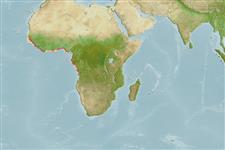
Eastern Atlantic: Senegal to Angola (Ref. 57413, 81660), including the islands of Guinea (Ref. 10812).
Taille / Poids / Âge
Maturité: Lm ? range ? - ? cm
Max length : 21.0 cm TL mâle / non sexé; (Ref. 57413)
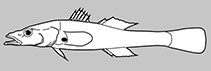
Épines dorsales (Total) : 7; Rayons mous dorsaux (Total) : 9; Épines anales: 1; Rayons mous anaux: 8. Diagnosis: 42-58 predorsal scales (Ref. 57413, 81660), extending to interorbital space (Ref. 57413). Cheek and opercle scaled (Ref. 81660). Small scales on operculum and preoperculum; 76-86 (perhaps up to 94) scales in longitudinal series (including 4 or more scales on caudal fin); 31-40 scales in rearward transverse series; 1st dorsal fin: VI; 2nd dorsal fin: I,9; anal fin: I,8; pectoral fins: 16 (Ref. 57413, 81660). Caudal fin rounded with 17 segmented rays, 15 of which are branched (Ref. 57413).
Coloration: Preserved specimens: dark brown or black, lighter ventrally (Ref. 57413, 81660). Several dark, vertical bars present along midline of flanks, last at base of caudal fin (Ref. 57413). Fins dark; a distinct dark spot on dorsal margin of caudal fin near its base; ventral margins of anal and caudal fins white; pelvics with white lateral margins (Ref. 57413, 81660).
Body shape (shape guide): fusiform / normal.
Found in estuaries and other brackish-water environments; occasionally entering freshwater (Ref. 57413, 81660). Food items include small crabs (Ref. 10812).
Cycle de vie et comportement reproducteur
Maturité | Reproduction | Frai | Œufs | Fécondité | Larves
Miller, P.J. and P. Wongrat, 1990. Eleotridae. p. 952-957. In J. C. Quéro, J. C. Hureau, C. Karrer, A. Post and L. Saldanha (eds.) Check-list of the fishes of the eastern tropical Atlantic (CLOFETA). JNICT, Lisbon; SEI, Paris; and UNESCO, Paris. Vol. 2. (Ref. 10812)
Statut dans la liste rouge de l'IUCN (Ref. 130435: Version 2025-2 (Global))
Menace pour l'homme
Harmless
Utilisations par l'homme
Pêcheries: sans intérêt
Outils
Articles particuliers
Télécharger en XML
Sources Internet
Estimations basées sur des modèles
Température préférée (Réf.
123201): 23.4 - 27.9, mean 26.5 °C (based on 64 cells).
Indice de diversité phylogénétique (Réf.
82804): PD
50 = 0.5010 [Uniqueness, from 0.5 = low to 2.0 = high].
Bayesian length-weight: a=0.00676 (0.00350 - 0.01307), b=3.08 (2.91 - 3.25), in cm total length, based on LWR estimates for this species & (Sub)family-body (Ref.
93245).
Niveau trophique (Réf.
69278): 4.0 ±0.7 se; based on size and trophs of closest relatives
Résilience (Réf.
120179): Haut, temps minimum de doublement de population inférieur à 15 mois (Preliminary K or Fecundity.).
Vulnérabilité de la pêche (Ref.
59153): Low vulnerability (16 of 100).
🛈
Nutriments (Ref.
124155): Calcium = 224 [121, 457] mg/100g; Iron = 1.05 [0.57, 1.89] mg/100g; Protein = 17.7 [16.0, 19.3] %; Omega3 = 0.149 [0.079, 0.267] g/100g; Selenium = 35.2 [18.0, 71.9] μg/100g; VitaminA = 27.5 [9.8, 66.8] μg/100g; Zinc = 1.84 [1.27, 2.67] mg/100g (wet weight);