Classificação / Nomes
Nomes comuns | Sinónimos | Catalog of Fishes(Género, Espécies) | ITIS | CoL | WoRMS | Cloffa
>
Characiformes (Characins) >
Curimatidae (Toothless characins)
Etymology: Steindachnerina: Named after Franz Steindachner, 1876; naturalist, ichthyologist that studied the fauna of Galápagos; seriata: Name from Latin 'seriata' meaning arranged in a series; referring to multiple series of narrow dark stripes situated along the scale row margins on the lateral and dorsolateral surface of the body in the species.
Eponymy: Franz Steindachner (1834–1919) was an Austrian zoologist who specialised in herpetology and ichthyology. [...] (Ref. 128868), visit book page.
More on authors: Netto-Ferreira & Vari.
Ambiente: milieu / zona climática / intervalo de profundidade / gama de distribuição
Ecologia
; Água doce pelágico(a,os,as). Tropical; 7°S - 8°S, 55°W - 56°W
South America: known only from two localities that lie relatively close to each other in the Rio Jamanxim, a right bank tributary of the Rio Tapajo´s in the eastern portions of the Amazon basin. Further sampling is necessary in order to determine whether S. seriata has a restricted range as proposed for various groups of Brazilian freshwater fishes by Nogueira et al. (2010). Alternatively, the apparent limited distribution for the
species might reflect the undersampling of the Rio Tapajo´s ichthyofauna as evidenced by the recent discovery of S. seriata and S. fasciata in that catchment (Ref. 88964).
Tamanho / Peso / Idade
Maturidade: Lm ? range ? - ? cm
Max length : 8.3 cm SL macho/indeterminado; (Ref. 88964)
Descrição breve
Chaves de identificação | Morfologia | Morfometria
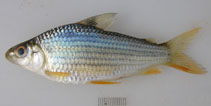
Steindachnerina seriata is distinguished from all congeners with the exception of S. fasciata by the presence of multiple narrow, dark stripes extending along the lateral and dorsolateral portion of the body. It differs from S. fasciata in the position on the scales of the dark stripes extending along the body (positioned along the areas of contact of proximate horizontal scale rows versus situated along the middle of the scales of each row, respectively), in the pigmentation pattern of the lateral surface of the caudal peduncle (the absence of a horizontally elongate, midlateral, dark stripe on the caudal peduncle versus the presence of such pigmentation, respectively), the distance from the tip of the snout to the origin of the anal fin (79.2–82.7% versus 84.1–88.9% of SL, respectively), the distance from the tip of the snout to the anus (76.2–78.0% versus 78.8–83.9% of SL, respectively), the length of the snout (33.5–34.6% versus 28.9–32.3% of HL, respectively), and the length of the postorbital portion of the head (36.3–38.8% versus 39.7–43.6% of HL, respectively). Steindachnerina seriata can be further distinguished from S. argentea, S. bimaculata, S. binotata, S. conspersa, S. leucisca, and S. notograptos in the form of the fleshy lining of the roof of the oral cavity (the presence of a distinct series of multiple very fleshy folds extending ventrally from the dorsal surface of the oral cavity versus the presence of only three weakly to moderately developed longitudinal folds in that region, respectively), from S. gracilis, S. hypostoma, S. planiventris, and S. quasimodoi in the transverse form of the prepelvic region (obtusely flattened versus distinctly flattened, respectively) and the number of scales across the transversely flattened prepelvic region immediately anterior to the insertion of the pelvic fins (3 or 4 versus 5 or 6 scales, respectively), from S. binotata, S. corumbae, S. dobula, S. hypostoma, S. insculpta, S. leucisca, S. notograptos, and S. varii in the pigmentation of the dorsal fin (the presence of a spot of dark pigmentation on the basal portions of the fin versus the absence of such pigmentation on the fin throughout ontogeny, respectively), from S. amazonica, S. argentea, S. atratoensis, S. biornata, S. brevipinna, S. conspersa, S. dobula, S. elegans, S. fasciata . S. guentheri, S. hypostoma, S. insculpta, S. notonota, and S. varii in the pigmentation pattern along the midlateral portions of the body and caudal fin (the absence of distinct dark pigmentation along the midlateral surface of the body and caudal fin versus the presence of a dark midlateral stripe extending along the lateral line and/or a patch of horizontally elongate dark pigmentation along the caudal peduncle and/or dark pigmentation along the middle caudal-fin rays, respectively) (Ref. 88964).
Collected in flooded areas along the margin of the river among stands of dense aquatic
vegetation (Ref. 88964).
Ciclo de vida e comportamento de acasalamento
Maturidade | Reprodução | Desova | Ovos | Fecundidade | Larvas
Netto-Ferreira, A.L. and R.P. Vari, 2011. New species of Steindachnerina (Characiformes: Curimatidae) from the Rio Tapajós, Brazil, and review of the genus in the Rio Tapajós and Rio Xingu basins. Copeia 2011(4):523-529. (Ref. 88964)
Categoria na Lista Vermelha da IUCN (Ref. 130435: Version 2025-2 (Global))
Ameaça para o homem
Harmless
Utilização humana
Ferramentas
Relatórios especiais
Descarregue XML
Fontes da internet
Estimativas baseadas em modelos
Índice de diversidade filogenética (Ref.
82804): PD
50 = 0.5000 [Uniqueness, from 0.5 = low to 2.0 = high].
Bayesian length-weight: a=0.01479 (0.00659 - 0.03318), b=3.01 (2.84 - 3.18), in cm total length, based on LWR estimates for this Genus-body shape (Ref.
93245).
Vulnerabilidade da pesca (Ref.
59153): Low vulnerability (10 of 100).
🛈