Elasmobranchi (squali e razze) (sharks and rays) >
Rajiformes (Skates and rays) >
Rajidae (Skates)
Etymology: Rostroraja: Latin, rostrum = beak + Latin, raja, -ae = a sting ray (Ref. 45335).
More on author: Lacepède.
Ambiente: milieu / zona climatica / distribuzione batimetrica / gamma di distribuzione
Ecologia
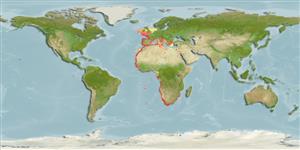
marino demersale; distribuzione batimetrica 30 - 600 m (Ref. 6808), usually 50 - 500 m (Ref. 26999). Subtropical; 56°N - 37°S, 19°W - 23°E
Eastern Atlantic and southwest Indian Ocean (British Isles to Mozambique) and the Mediterranean Sea.
Dimensione / Peso / Età
Maturità: Lm ? range ? - ? cm
Max length : 230 cm TL maschio/sesso non determinato; (Ref. 11284); 202.0 cm TL (female)
Breve descrizione
Chiavi di identificazione | Morfologia | Morfometria
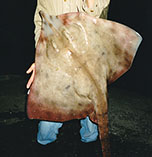
A giant skate with a broad-based, abruptly narrow-tipped snout covered with small, sharp thorns; pectoral disc angular, and no thorns on nape or back, but three rows of large thorns on tail (Ref. 5578). Larger immature and adult individuals grey with numerous small white spots above, underside white with no black pores; hatchlings plain reddish-brown above, often with blue spots, and white below with broad dusky grey margins on disc (Ref. 5578).
Body shape (shape guide): other.
Inhabit shelf and slope waters (Ref. 4426). Found on sand and rock-sand bottom (Ref. 6808). A bottom-predator of bony fishes, other elasmobranchs, fish offal, crabs, shrimps, mysids, octopi, and cuttlefish (Ref. 5578). Minimum depth reported taken from Ref. 4426. Maximum length for female is 202 cm (Ref. 41333). Oviparous. Distinct pairing with embrace. Young may tend to follow large objects, such as their mother (Ref. 205). Eggs are oblong capsules with stiff pointed horns at the corners deposited in sandy or muddy flats (Ref. 205). Egg capsules are 12.5-18.3 cm long and 10.0-13.9 cm wide (Ref. 41250). About 55-156 eggs are produced per individual annually (Ref. 41250).
Ciclo vitale e comportamento di accoppiamento
Maturità | Riproduzione | Deposizione | Uova | Fecondità | Larve
Oviparous, paired eggs are laid. Embryos feed solely on yolk (Ref. 50449). Eggs are laid in huge cases and take up to 18 months to hatch (Ref. 5578). Distinct pairing with embrace. Young may tend to follow large objects, such as their mother (Ref. 205).
McEachran, J.D. and K.A. Dunn, 1998. Phylogenetic analysis of skates, a morphologically conservative clade of elasmobranchs (Chondrichthyes: Rajidae). Copeia 1998(2):271-290. (Ref. 27314)
Stato della Lista Rossa IUCN (Ref. 130435: Version 2025-2 (Global))
Minaccia per l'uomo
Traumatogenic (Ref. 5578)
Usi umani
Pesca: scarso interesse commerciale; Pesce da pesca sportiva: si
Strumenti
Rapporti speciali
Scarica XML
Fonti Internet
Stime basate su modelli
Temperatura preferita (Fonte Biblio.
123201): 8.8 - 17.5, mean 13.5 °C (based on 474 cells).
Indice di diversità filogenetica (Fonte Biblio.
82804): PD
50 = 0.5039 [Uniqueness, from 0.5 = low to 2.0 = high].
Bayesian length-weight: a=0.00302 (0.00258 - 0.00354), b=3.23 (3.19 - 3.27), in cm total length, based on LWR estimates for this species (Ref.
93245).
Livello trofico (Fonte Biblio.
69278): 4.4 ±0.83 se; based on food items.
Resilienza (Fonte Biblio.
120179): Basso, tempo minimo di raddoppiamento della popolazione 4.5 - 14 anni (Fec=55).
Vulnerabilità della pesca (Ref.
59153): Very high vulnerability (90 of 100).
🛈
Nutrienti (Ref.
124155): Calcium = 11.3 [2.5, 57.1] mg/100g; Iron = 0.67 [0.17, 1.98] mg/100g; Protein = 17.9 [15.2, 20.5] %; Omega3 = 0.497 [0.171, 1.832] g/100g; Selenium = 34.5 [10.7, 119.7] μg/100g; VitaminA = 9.38 [3.06, 30.12] μg/100g; Zinc = 0.375 [0.184, 0.690] mg/100g (wet weight);