Elasmobranchii (tubarões e raias) (sharks and rays) >
Lamniformes (Mackerel sharks) >
Odontaspididae (Sand tiger sharks)
Etymology: Odontaspis: Etymology not explained, presumably odontos (Gr.), tooth, and aspis (Gr.), shield, perhaps referring to how teeth comprise a prominent narrow cusp provided with two or more small “side teeth” (translation), i.e., cusplets, which, with some imagination, could be said to “shield” the main cusp; another explanation: aspis (L.), viper, perhaps referring to outwardly pointing teeth of O. ferox, like that of a viper (See ETYFish); noronhai: In honor of Adolfo César de Noronha (1873-1963), late director of the Funchal Museum (Madeira), where holotype is housed (See ETYFish).
Eponymy: Adolfo César de Noronha (1873–1963) was a naturalist and librarian who was Director of the Funchal Museum in Madeira (where the type specimen of the shark is housed). [...] (Ref. 128868), visit book page.
Ambiente: milieu / zona climática / intervalo de profundidade / gama de distribuição
Ecologia
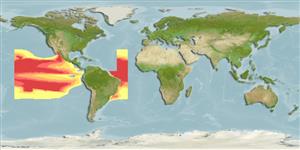
marinhas pelagic-oceanic; intervalo de profundidade 60 - 1000 m (Ref. 10722). Deep-water; 31°N - 34°S, 163°W - 27°W (Ref. 54682)
Eastern Atlantic: Madeira and southern Brazil. Eastern Central Pacific: off Hawaii. May eventually be recorded from the Western Central Pacific (Ref. 13568). Questionably occurring in Seychelles.
Comprimento na primeira maturidade / Tamanho / Peso / Idade
Maturidade: Lm 325.0 range ? - ? cm
Max length : 367 cm TL macho/indeterminado; (Ref. 247); 326.0 cm TL (female)
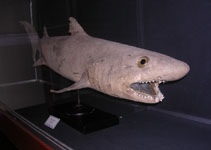
Snout conical and bulbous, tip rounded. Eyes large and ovoid, nictitating membrane absent. Body color uniform chocolate brown, all fins except pectorals with thin dark edging along posterior margin.
Body shape (shape guide): fusiform / normal.
A deepwater shark inhabiting the continental and insular slopes (Ref. 50449, 58302). Pelagic (Ref. 58302). Ovoviviparous, embryos feeding on yolk sac and other ova produced by the mother (Ref. 50449). Feeding habits unknown.
Ciclo de vida e comportamento de acasalamento
Maturidade | Reprodução | Desova | Ovos | Fecundidade | Larvas
Exhibit ovoviparity (aplacental viviparity), with embryos feeding on other ova produced by the mother (oophagy) after the yolk sac is absorbed (Ref. 50449). Distinct pairing with embrace (Ref. 205).
Compagno, L.J.V., 1984. FAO Species Catalogue. Vol. 4. Sharks of the world. An annotated and illustrated catalogue of shark species known to date. Part 1 - Hexanchiformes to Lamniformes. FAO Fish. Synop. 125(4/1):1-249. Rome, FAO. (Ref. 247)
Categoria na Lista Vermelha da IUCN (Ref. 130435: Version 2025-2 (Global))
Ameaça para o homem
Harmless
Utilização humana
Pescarias: de interesse potencial
Ferramentas
Relatórios especiais
Descarregue XML
Fontes da internet
Estimativas baseadas em modelos
Temperatura preferida (Ref.
123201): 8.6 - 15.2, mean 12 °C (based on 13 cells).
Índice de diversidade filogenética (Ref.
82804): PD
50 = 1.0000 [Uniqueness, from 0.5 = low to 2.0 = high].
Bayesian length-weight: a=0.01122 (0.00514 - 0.02450), b=3.04 (2.87 - 3.21), in cm total length, based on all LWR estimates for this body shape (Ref.
93245).
Nível Trófico (Ref.
69278): 4.4 ±0.4 se; based on size and trophs of closest relatives
Resiliência (Ref.
120179): Muito baixo, tempo mínimo de duplicação da população maior que 14 anos (Fec assumed to be <10).
Vulnerabilidade da pesca (Ref.
59153): Very high vulnerability (90 of 100).
🛈