Myxini (mixinas) (hagfishes) >
Myxiniformes (Hagfishes) >
Myxinidae (Hagfishes) > Myxininae
Etymology: Myxine: Ancient Greek word for a slimy fish: myxa, slime; -inus, one who, referring to copious amounts of slime produced by M. glutinosa (See ETYFish); robinsorum: -orum, commemorative suffix (L.), plural: in honor of American ichthyologists C. Richard Robins (1928-2020) and his wife Catherine, for their work on the fishes of the tropical western Atlantic (See ETYFish).
Eponymy: Dr Charles Richard ‘Dick’ Robins (1928–2020) was an American systematic ichthyologist whom one etymology honoured as an ‘eelologist’; as well as a colleague, advisor and friend, for his contributions to the knowledge of fishes (including [...] (Ref. 128868), visit book page.
Ambiente: milieu / zona climática / intervalo de profundidade / gama de distribuição
Ecologia
marinhas batidemersal; não migratória; intervalo de profundidade 783 - 1768 m (Ref. 31276). Deep-water
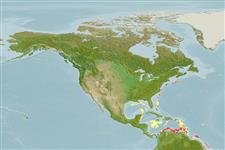
Western Central Atlantic: southern Caribbean Sea.
Tamanho / Peso / Idade
Maturidade: Lm ? range ? - ? cm
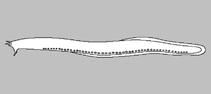
Max length : 54.0 cm TL macho/indeterminado; (Ref. 31276)
Ciclo de vida e comportamento de acasalamento
Maturidade | Reprodução | Desova | Ovos | Fecundidade | Larvas
Copulatory organ absent. The gonads of hagfishes are situated in the peritoneal cavity. The ovary is found in the anterior portion of the gonad, and the testis is found in the posterior part. The animal becomes female if the cranial part of the gonad develops or male if the caudal part undergoes differentiation. If none develops, then the animal becomes sterile. If both anterior and posterior parts develop, then the animal becomes a functional hermaphrodite. However, hermaphroditism being characterised as functional needs to be validated by more reproduction studies (Ref. 51361 ).
Fernholm, B., 1998. Hagfish systematics. p. 33-44. In J.M. Jørgensen, J.P. Lomholt, R.E. Weber and H. Malte (eds.) The biology of hagfishes. Chapman & Hall, London. 578 p. (Ref. 31276)
Categoria na Lista Vermelha da IUCN (Ref. 130435: Version 2025-2 (Global))
Ameaça para o homem
Harmless
Utilização humana
Ferramentas
Relatórios especiais
Descarregue XML
Fontes da internet
Estimativas baseadas em modelos
Índice de diversidade filogenética (Ref.
82804): PD
50 = 0.5000 [Uniqueness, from 0.5 = low to 2.0 = high].
Bayesian length-weight: a=0.00115 (0.00045 - 0.00294), b=3.03 (2.81 - 3.25), in cm total length, based on LWR estimates for this (Sub)family-body shape (Ref.
93245).
Nível Trófico (Ref.
69278): 3.4 ±0.6 se; based on size and trophs of closest relatives
Resiliência (Ref.
120179): Baixo, tempo mínimo de duplicação da população 4,5 - 14 anos (Fec assumed to be <100).
Vulnerabilidade da pesca (Ref.
59153): Moderate vulnerability (42 of 100).
🛈