>
Gobiiformes (Gobies) >
Gobiidae (Gobies) > Gobiinae
Etymology: Mahidolia: Named for His Royal Highness Prince Mahidol of Songkla, for his interest in the fishes and fisheries of Siam (Smith, 1932 original publication).
Eponymy: Mahidol Adulyadej (1892–1929), Prince of Songkla, was honoured for his interest in the fishes and fisheries of Siam (Thailand). (Ref. 128868), visit book page.
More on author: Valenciennes.
Ambiente: milieu / zona climática / intervalo de profundidade / gama de distribuição
Ecologia
marinhas; estuarina associadas(os) a recifes; intervalo de profundidade 5 - 20 m (Ref. 86942), usually 5 - 20 m (Ref. 37816). Tropical; 32°N - 20°S
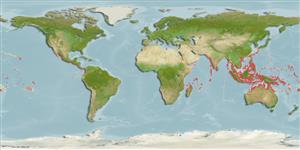
Indo-Pacific: East Africa south to Delagoa Bay, Mozambique (Ref. 2798) and east to the Society Islands, north to southern Japan (?), south to northern Australia and Samoa.
Tamanho / Peso / Idade
Maturidade: Lm ? range ? - ? cm
Max length : 8.0 cm TL macho/indeterminado; (Ref. 9710)
Descrição breve
Chaves de identificação | Morfologia | Morfometria
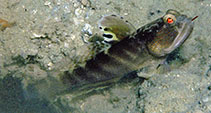
Espinhos dorsais (total) : 7; Raios dorsais moles (total) : 10; Espinhos anais: 1; Raios anais moles: 9. Characterized by generally pale grey to yellowish body color; about six slightly diagonal bands on body; head with orange spots; usually with one or more black spots on first dorsal fin; variable coloration of fins; first dorsal fin, fan like; united pelvic fins, frenum present; longitudinal scale series 33-37; head without scales; greatest depth of body 3.9-4.4 in SL; rounded caudal fin, about equal to head length (Ref. 90102).
Body shape (shape guide): elongated; Cross section: circular.
Occurs in silty coastal bays (Ref. 9710). Enters estuaries (Ref. 4343) and freshwater tidal zone habitats (Ref. 12693). Found on muddy bottom at the base of the reef at Toguan Bay, Guam. Uses the burrow of a mottled brown alpheid prawn with two or more short white saddles or spots. Lives coastal sand and mud habitats from shallow estuaries to moderate depths on slopes (Ref. 48637).
Ciclo de vida e comportamento de acasalamento
Maturidade | Reprodução | Desova | Ovos | Fecundidade | Larvas
Myers, R.F., 1991. Micronesian reef fishes. Second Ed. Coral Graphics, Barrigada, Guam. 298 p. (Ref. 1602)
Categoria na Lista Vermelha da IUCN (Ref. 130435: Version 2025-2 (Global))
Ameaça para o homem
Harmless
Utilização humana
Pescarias: espécies comerciais; Aquário: Espécies comerciais
Ferramentas
Relatórios especiais
Descarregue XML
Fontes da internet
Estimativas baseadas em modelos
Temperatura preferida (Ref.
123201): 25.9 - 29.1, mean 28.3 °C (based on 818 cells).
Índice de diversidade filogenética (Ref.
82804): PD
50 = 0.7500 [Uniqueness, from 0.5 = low to 2.0 = high].
Bayesian length-weight: a=0.00741 (0.00347 - 0.01582), b=3.09 (2.91 - 3.27), in cm total length, based on LWR estimates for this (Sub)family-body shape (Ref.
93245).
Nível Trófico (Ref.
69278): 4.0 ±0.65 se; based on food items.
Resiliência (Ref.
120179): Elevada, tempo mínimo de duplicação da população menor que 15 meses (Preliminary K or Fecundity.).
Vulnerabilidade da pesca (Ref.
59153): Low vulnerability (10 of 100).
🛈
Nutrientes (Ref.
124155): Calcium = 147 [71, 314] mg/100g; Iron = 0.777 [0.381, 1.547] mg/100g; Protein = 18.5 [16.5, 20.2] %; Omega3 = 0.111 [0.045, 0.229] g/100g; Selenium = 21.1 [8.3, 56.7] μg/100g; VitaminA = 145 [38, 510] μg/100g; Zinc = 2.21 [1.35, 3.34] mg/100g (wet weight);