>
Siluriformes (Catfishes) >
Loricariidae (Armored catfishes) > Hypostominae
Etymology: Hypostomus: Greek, hypo = under + Greek, stoma = mouth (Ref. 45335).
Eponymy: Dr Philibert Commerson (1727–1773) was known as ‘doctor, botanist and naturalist of the King’. [...] (Ref. 128868), visit book page.
More on author: Valenciennes.
Ambiente: milieu / zona climatica / distribuzione batimetrica / gamma di distribuzione
Ecologia
; acqua dolce demersale; potamodromo (Ref. 51243). Subtropical
South America: Lower Paraná including the Iguazú, Paraguay, Río de la Plata and Dulce Rivers.
Dimensione / Peso / Età
Maturità: Lm ? range ? - ? cm
Max length : 60.5 cm TL maschio/sesso non determinato; (Ref. 79585); peso massimo pubblicato: 1.8 kg (Ref. 79585)
Breve descrizione
Chiavi di identificazione | Morfologia | Morfometria
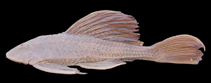
Spine dorsali (totale) : 2; Raggi dorsali molli (totale) : 7; Spine anali: 1; Raggi anali molli: 4. This species is distinguished by the following characters: teeth bifid teeth (vs. spoon-shaped); dark spots on a light background (vs light spots on a dark background or not spotted); 4 rough lateral ridges on flanks (vs. absent); 26-29 lateral series plates (vs. < 28 in several species, 31-32 in H. laplatae); 1-2 plates bordering posterior margin of the supraoccipital bone (vs. 3-4 in H. laplatae); differs from H. affinis, H. punctatus, H. ancistroides by having inter-dorsal distance 14.4-19.5% in SL (vs. 18.9-21.0%); head depth 49.0-71.6% in HL (vs. 48.2-49.9); differs from H. spiniger by having fine lateral ridges with odontodes posteriorly inclined (vs. large lateral ridges with odontodes in all directions), weak lateral ridges in caudal peduncle (vs. strong), mid lateral ridge from first plate (vs. ridge from 2nd or 3rd plates); adult of this species (> 12.0 cm SL) can be distinguished from adult H. spiniger by having a strong ridge on temporal plate (vs. very week) (Ref. 121236).
Body shape (shape guide): elongated; Cross section: angular.
Facultative air-breathing in the genus (Ref. 126274); Occurs in rivers where substrate from which specimens were obtained was composed chiefly of muddy sand. This species was found in moderately oxygenated waters (6.1-9.1 mg/l) with moderate current; water turbidity 23.7-442 NTU, conductivity 1.087-2.654 μS/cm, pH 7.2-9.2, and temperature 16.8-27.8°C (Ref. 121236).
Ciclo vitale e comportamento di accoppiamento
Maturità | Riproduzione | Deposizione | Uova | Fecondità | Larve
Cardoso, Y.P., F. Brancolini, L. Protogino, A. Paracampo, S. Bogan, P. Posadas and J.I. Montoya-Burgos, 2019. An integrated approach clarifies the cryptic diversity in Hypostomus Lacépède 1803 from the Lower La Plata Basin. Anais da Academia Brasileira de Ciéncias 91(2):e20180131: [1-25]. (Ref. 121236)
Stato della Lista Rossa IUCN (Ref. 130435: Version 2025-2 (Global))
Minaccia per l'uomo
Harmless
Usi umani
Pesca: commerciale; Acquario: Commerciale
Strumenti
Rapporti speciali
Scarica XML
Fonti Internet
Stime basate su modelli
Indice di diversità filogenetica (Fonte Biblio.
82804): PD
50 = 0.5000 [Uniqueness, from 0.5 = low to 2.0 = high].
Bayesian length-weight: a=0.01778 (0.01490 - 0.02122), b=2.95 (2.92 - 2.98), in cm total length, based on LWR estimates for this species (Ref.
93245).
Resilienza (Fonte Biblio.
120179): Molto basso, tempo minimo di raddoppiamento della popolazione più di 14 anni (Preliminary K or Fecundity.).
Vulnerabilità della pesca (Ref.
59153): Moderate vulnerability (44 of 100).
🛈