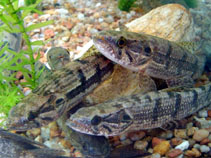
Ambiente: milieu / zona climática / intervalo de profundidade / gama de distribuição
Ecologia
; Água doce bentopelágico; pH range: 6.0 - 8.0; dH range: 4 - 25; potamódromo (Ref. 51243). Tropical; 20°C - 26°C (Ref. 2060); 11°N - 35°S, 85°W - 35°W
Central and South America: Costa Rica to Argentina in most rivers basins.
Comprimento na primeira maturidade / Tamanho / Peso / Idade
Maturidade: Lm ?, range 17 - ? cm
Max length : 65.0 cm TL macho/indeterminado; (Ref. 111518); peso máx. Publicado: 3.8 kg (Ref. 111518)
Descrição breve
Chaves de identificação | Morfologia | Morfometria
Occurs in diverse habitats from free flowing clear water streams, well up into the valleys, to slow turbid waters, water courses, irrigation and drainage ditches, and ponds on the plains (Ref. 11225). Rests in vegetation during the day and is active at night (Ref. 6858). Adults feed on fish; juveniles feed on crustacean and insect larvae (Ref. 26543), shrimps and other small invertebrates (Ref. 12225). Spawn in pits located in shallow water at a temperature of about 26°C (Ref. 205). Males guard the nests even after the eggs have hatched (Ref. 205). Reaches more than 3 kg (Mark Fitzgerald, pers. comm., 2001). Live fish are difficult to handle and potentially dangerous because of their sharp teeth, strong jaws, and slippery bodies.
Ciclo de vida e comportamento de acasalamento
Maturidade | Reprodução | Desova | Ovos | Fecundidade | Larvas
Eggs are fertilized in the cupped anal fin of the female. When the eggs get sticky, they are dropped into a pit which will be guarded by the male even until after the eggs have hatched (Ref. 205).
Planquette, P., P. Keith and P.-Y. Le Bail, 1996. Atlas des poissons d'eau douce de Guyane. Tome 1. Collection du Patrimoine Naturel Volume 22, MNHN, Paris & INRA, Paris. 429 p. (Ref. 12225)
Categoria na Lista Vermelha da IUCN (Ref. 130435: Version 2025-2 (Global))
Ameaça para o homem
Other
Utilização humana
Pescarias: espécies comerciais; Aquacultura: espécies comerciais; peixe desportivo: sim; Aquário: Aquários públicos
Ferramentas
Relatórios especiais
Descarregue XML
Fontes da internet
Estimativas baseadas em modelos
Índice de diversidade filogenética (Ref.
82804): PD
50 = 0.5000 [Uniqueness, from 0.5 = low to 2.0 = high].
Bayesian length-weight: a=0.00891 (0.00750 - 0.01059), b=3.10 (3.05 - 3.15), in cm total length, based on LWR estimates for this species (Ref.
93245).
Nível Trófico (Ref.
69278): 4.5 ±0.0 se; based on diet studies.
Resiliência (Ref.
120179): Baixo, tempo mínimo de duplicação da população 4,5 - 14 anos (K=0.08).
Vulnerabilidade da pesca (Ref.
59153): High to very high vulnerability (66 of 100).
🛈
Nutrientes (Ref.
124155): Calcium = 61.6 [25.6, 142.6] mg/100g; Iron = 1.1 [0.6, 2.5] mg/100g; Protein = 18.2 [16.2, 20.4] %; Omega3 = 0.324 [0.133, 0.812] g/100g; Selenium = 90.5 [35.2, 203.6] μg/100g; VitaminA = 65.9 [24.2, 183.1] μg/100g; Zinc = 1.1 [0.8, 1.5] mg/100g (wet weight);