Taxonomic Remarks
Eastern Atlantic populations of Bathytoshia centroura refer to Bathytoshia lata according to Last et al, 2016 (Ref. 114953). Species distribution will be corrected as soon as possible;
Meio ambiente: milieu / Zona climática / intervalo de profundidade / faixa de distribuição
Ecologia
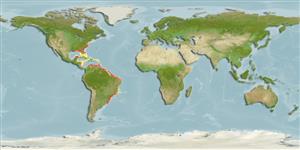
marinhas; estuarina demersal; intervalo de profundidade 3 - 270 m (Ref. 57911), usually 15 - 50 m (Ref. 4438). Subtropical; 45°N - 35°S, 90°W - 36°E
Western Atlantic: antitropical; from western and southern USA, including the Gulf of Mexico, and Brazil to Argentina (Ref. 114953). Eastern Atlantic populations refer to Bathytoshia lata (Ref. 109651, 114953).
Comprimento de primeira maturação / Tamanho / Peso / Idade
Maturidade: Lm 116.5, range 66 - 160 cm
Max length : 300 cm TL macho/indeterminado; (Ref. 27549); common length : 125 cm WD macho/indeterminado; (Ref. 26999); peso máx. publicado: 300.0 kg (Ref. 57911)
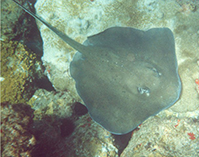
Diagnosis: Large specimens of Dasyatis centroura are recognizable by their thorny tails, by the large size and wide spacing spacing of their mid-dorsal bucklers, and by the conspicuous tubercles or bucklers on the outer parts of their discs; in smaller specimens the large tubercles have not yet developed on the tail (Ref. 6902). It differs from Dasyatis sabina, D. guttata and Himantura schmardae in the shape of disc; it resembles Dasyatis say and D. americana in shape of disc, but it can be distinguished from D. say by the fact that the tail lacks any trace of a cutaneous fold above, and from D. americana by its much narrower ventral tailfold (Ref. 6902).
Body shape (shape guide): other; Cross section: flattened.
Dasyatis centroura is a coastal species (Ref. 81259), found over sandy and muddy bottoms (Ref. 3169). It feeds on bottom-living invertebrates and fishes (Ref. 3169). Ovoviviparous (Ref. 6901). Wings marketed fresh, smoked, dried-salted; used for fishmeal and oil. Harmful to shellfish banks; dangerous to bathers and fishers due to its poisonous spine. May attain well over 100 cm TL. Warm season visitor to coastal waters (Ref. 6902).
Exhibit ovoviparity (aplacental viviparity), with embryos feeding initially on yolk, then receiving additional nourishment from the mother by indirect absorption of uterine fluid enriched with mucus, fat or protein through specialised structures (Ref. 50449). Gestation about 4 months with 2 to 4 young produced in autumn and early winter (Ref. 6901). Distinct pairing with embrace (Ref. 205).
Last, P.R., W.T. White, M.R. de Carvalho, B. Séret, M.F.W. Stehmann and G.J.P. Naylor, 2016. Rays of the world. CSIRO Publishing, Comstock Publishing Associates. i-ix + 1-790. (Ref. 114953)
Status na Lista Vermelha da UICN (Ref. 130435: Version 2025-2 (Global))
Ameaça para os humanos
Venomous
Uso pelos humanos
Pescarias: pouco comercial; peixe esportivo: sim
Ferramentas
Relatórios especiais
Baixar XML
Fontes da internet
Estimativas baseadas em modelos
Temperatura preferida (Ref.
123201): 14.6 - 27.7, mean 23.1 °C (based on 772 cells).
Índice de diversidade filogenética (Ref.
82804): PD
50 = 0.6250 [Uniqueness, from 0.5 = low to 2.0 = high].
Bayesian length-weight: a=0.00447 (0.00189 - 0.01058), b=3.12 (2.92 - 3.32), in cm total length, based on LWR estimates for this (Sub)family-body shape (Ref.
93245).
Nível Trófico (Ref.
69278): 3.8 ±0.0 se; based on diet studies.
Resiliência (Ref.
120179): Muito baixo(a), tempo mínimo de duplicação da população maior que 14 anos (Fec=2-6).
Vulnerabilidade da pesca (Ref.
59153): Very high vulnerability (90 of 100).
🛈
Vulnerabilidade climática (Ref.
125649): Moderate vulnerability (39 of 100).
🛈
Nutrientes (Ref.
124155): Calcium = 12 [2, 54] mg/100g; Iron = 0.627 [0.158, 1.732] mg/100g; Protein = 23 [20, 26] %; Omega3 = 0.272 [0.080, 0.798] g/100g; Selenium = 34.5 [9.9, 96.0] μg/100g; VitaminA = 3.84 [1.53, 9.51] μg/100g; Zinc = 0.47 [0.24, 0.84] mg/100g (wet weight); based on
nutrient studies.