Classificação / Nomes
Nomes comuns | Sinónimos | Catalog of Fishes(Género, Espécies) | ITIS | CoL | WoRMS | Cloffa
>
Cichliformes (Cichlids, convict blennies) >
Cichlidae (Cichlids) > Cichlinae
Etymology: Congolapia: Congolapia is a contraction of the words Congo and Tilapia; all species of Congolapia are only known from the central Congo basin.
Ambiente: milieu / zona climática / intervalo de profundidade / gama de distribuição
Ecologia
; Água doce pelágico(a,os,as). Tropical
Africa: the western central Congo basin (Republic of Congo and Democratic Republic of the Congo), from the Alima, Lefini, Sangha, Pool Malebo, Itimbiri and from affluents of Luilaka (Ref. 92878).
Tamanho / Peso / Idade
Maturidade: Lm ? range ? - ? cm
Max length : 14.7 cm SL macho/indeterminado; (Ref. 92878)
Descrição breve
Chaves de identificação | Morfologia | Morfometria
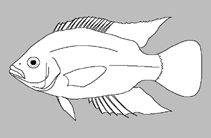
Espinhos dorsais (total) : 16 - 17; Raios dorsais moles (total) : 8 - 10; Espinhos anais: 3; Raios anais moles: 7 - 9. Diagnosis: Congolapia crassa differs from C. bilineata by having two complete scale rows between the upper lateral line and the base of the last dorsal spine and one additional row of very small scales in-between vs. one complete scale row and one additional scale row with smaller dorsoventrally compressed scales between the upper lateral line and the base of the last dorsal spine (Ref. 92878). It is distinguished from C. louna by a lower number of gill rakers on first ceratobranchial, 8-11 vs. 13 (Ref. 92878). Further, C. crassa differs from C. bilineata and C. louna by a greater body depth with only a minimal overlap, 40.4-48.4% of standard length vs. 32-2-40.5% and 37.4-42.1% respectively (Ref. 92878). All scales cycloid; 25-27 scales on horizontal line; 18-21 upper lateral line scales; 8-11 lower lateral line scales (Ref. 92878).
Colour: Background colour reddish-brown to bluish, chest and belly light brown to whitish with small reddish elements and dorsum darker brown, especially in range of backward slanted, unbranched (not Y-shaped) bars; flank below lateral line more bluish; lower half of head light brown to reddish and upper half of head dark olive-brown; upper lip turquoise and lower lip whitish; a horizontal iridescent turquoise line above anterorostral margin of preopercle; base of pectoral fin whitish edged; iris reddish brown (Ref. 92878). Apparently depending on motivational state, body with five or six black, broad, backward slanted, unbranched (not Y-shaped) bars and a nape band; bluish thin lachrymal stripe extending from lachrymal to jaw angle; black opercular spot, extended into sloping stripe (Ref. 92878). Pectoral fin light yellowish to hyaline, pelvic and anal fin greenish yellow; dorsal fin reddish-brown to yellow-whitiwh edged, black 'tilapia spot' present; caudal fin reddish-brown to yellow, whitish edged (Ref. 92878).
Congolapia crassa is found in grass-bank as well as forest-bank habitats, and this during the dry as well as wet season (Ref. 92878).
Ciclo de vida e comportamento de acasalamento
Maturidade | Reprodução | Desova | Ovos | Fecundidade | Larvas
Dunz, A.R., E. Vreven and U.K. Schliewen, 2012. Congolapia, a new cichlid genus from the central Congo basin (Perciformes: Cichlidae). Ichthyol. Explor. Freshwat. 23(2):155-179. (Ref. 92878)
Categoria na Lista Vermelha da IUCN (Ref. 130435: Version 2025-2 (Global))
Ameaça para o homem
Harmless
Utilização humana
Ferramentas
Relatórios especiais
Descarregue XML
Fontes da internet
Estimativas baseadas em modelos
Índice de diversidade filogenética (Ref.
82804): PD
50 = 0.6250 [Uniqueness, from 0.5 = low to 2.0 = high].
Bayesian length-weight: a=0.00776 (0.00352 - 0.01710), b=3.12 (2.94 - 3.30), in cm total length, based on LWR estimates for this (Sub)family-body shape (Ref.
93245).
Nível Trófico (Ref.
69278): 3.2 ±0.5 se; based on size and trophs of closest relatives
Resiliência (Ref.
120179): Elevada, tempo mínimo de duplicação da população menor que 15 meses (Preliminary K or Fecundity.).
Vulnerabilidade da pesca (Ref.
59153): Low vulnerability (10 of 100).
🛈