Ταξινόμηση / Ονόματα
Κοινά ονόματα | Συνώνυμα | Catalog of Fishes(Γένος, Είδη) | ITIS | CoL | WoRMS | Cloffa
>
Cichliformes (Cichlids, convict blennies) >
Cichlidae (Cichlids) > Cichlasomatinae
Etymology: Bujurquina: A name created by Kullander, taken from a native Peruvian word for these cichlids, "bujurqui" or "bufurque"; 1983-1986; pardus: From the Ancient Greek pardos, meaning leopard, in allusion to the pattern of dark blackish/brown flank spots. A noun in apposition.
Περιβάλλον: περιβάλλον / κλιματική ζώνη / εύρος βάθους / εύρος διανομής
Οικολογία
; Γλυκού νερού βενθοπελαγικό; pH range: 6.4 - ?; εύρος βάθους 1 - ? m (Ref. 96081). Tropical; 24°C - ? (Ref. 96081)
South America: Rio Danta, Rio Tigre drainage in Ecuador.
Μέγεθος / Βάρος / Ηλικία
Γεννητική Ωρίμανση: Lm ? range ? - ? cm
Max length : 7.7 cm SL αρσενικό/απροσδιόριστο; (Ref. 96081)
Σύντομη περιγραφή
Κλείδες προσδιορισμού | Μορφολογία | Μορφομετρία
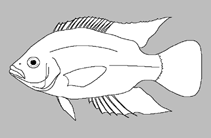
Ραχιαίες άκανθες (συνολικά) : 13 - 14; Μαλακές ραχιαίες ακτίνες (συνολικά) : 9 - 10; Εδρικές άκανθες: 3; Μαλακές εδρικές ακτίνες: 8. Bujurquina pardus is distinguished from all other congeners by having small, square or tapered black spots ('pardus type') in the region of overlap between the scale base and the anterior overlaying scale's margin. It differs from all other Bujurquina species (B. huallagae, B. moriorum, B. peregrinabunda, and B. ortegai) by the presence of white hyaline margins on the dorsal-fin lappets. It can be distinguished from all congeners except B. eurhinus, B. robusta, B. labiosa, B. huallagae, and B. oenolaemus by having a short pectoral fins (<32% of SL). It further differs from B. oenolaemus, B. cordemadi, B. tambopatae, B. eurhinus, B. labiosa, B. robusta, B. apoparuana, B. hophrys, B. megalospilus, B. ortegai, B. mariae, and B. zamorensis by the presence of light spotting on the spinous dorsal fin. It can be diagnosed from a very similar species B. huallagae, on the basis of the presence of white dorsal-fin lappet margins (rather than black), a strongly curved suborbital stripe (rather than straight or nearly straight), a complete bar 7 (rather than divided), and in having faint buccal stripes (rather than dark buccal spots) (Ref. 96081).
Found in a whitewater habitat of Rio Danta with a substrate of sand and silt, a relatively fast current, little aquatic vegetation and primary forest on the riverbanks. Collected with 4 m seines from the middle of the current at a depth of 1.2 m (Ref. 96081).
Κύκλος ζωής και συμπεριφορά ζευγαρώματος
Γεννητική Ωρίμανση | Αναπαραγωγή | Γεννοβολία | Αβγά | Γονιμότητα | Προνύμφες
Arbour, J.H., R.E.B. Salazar and H. López-Fernández, 2014. A new species of Bujurquina (Teleostei: Cichlidae) from the Río Danta, Ecuador, with a key to the species in the genus. Copeia 2014(1):79-86. (Ref. 96081)
Κατάσταση Κόκκινου Καταλόγου IUCN (Ref. 130435: Version 2025-2 (Global))
Απειλή για τον άνθρωπο
Harmless
Ανθρώπινες χρήσεις
Εργαλεία
Ειδικές εκθέσεις
Λήψη XML
Διαδικτυακές πηγές
Εκτιμήσεις βάσει μοντέλων
Δείκτης φυλογενετικής ποικιλότητας (Αναφ.
82804): PD
50 = 0.5000 [Uniqueness, from 0.5 = low to 2.0 = high].
Bayesian length-weight: a=0.02188 (0.01025 - 0.04670), b=3.05 (2.87 - 3.23), in cm total length, based on LWR estimates for this (Sub)family-body shape (Ref.
93245).
Τροφικό Επίπεδο (Αναφ.
69278): 3.4 ±0.6 se; based on size and trophs of closest relatives
Ελαστικότητα (Αναφ.
120179): Υψηλό, ελάχιστος χρόνος για διπλασιασμό πληθυσμού < 15 μήνες (Preliminary K or Fecundity.).
Ευπάθεια στην αλιεία (Ref.
59153): Low vulnerability (10 of 100).
🛈