>
Cichliformes (Cichlids, convict blennies) >
Cichlidae (Cichlids) > Astronotinae
Etymology: Astronotus: Greek, astra = ray + Greek, noton = back (Ref. 45335).
More on author: Agassiz.
Taxonomic Remarks
Redescription of Peruvian material in Kullander (1986: 61), with diagnosis, description, distribution, and illustrations. The species is reported from the Rio Orinoco drainage and numerous localities in the Rio Amazonas basin, but apparently several species are confused under the name, and names in the synonymy may represent valid species.
Ambiente: milieu / zona climatica / distribuzione batimetrica / gamma di distribuzione
Ecologia
; acqua dolce benthopelagico; pH range: 6.0 - 8.0; dH range: 5 - 19. Tropical; 22°C - 25°C (Ref. 1672); 4°N - 15°S, 78°W - 47°W
South America: western Amazon and Orinoco basins. Introduced elsewhere.
Lunghezza alla prima maturità / Dimensione / Peso / Età
Maturità: Lm 12.0 range ? - ? cm
Max length : 45.7 cm TL maschio/sesso non determinato; (Ref. 40637); common length : 24.0 cm TL maschio/sesso non determinato; (Ref. 12193); peso massimo pubblicato: 1.6 kg (Ref. 40637)
Breve descrizione
Chiavi di identificazione | Morfologia | Morfometria
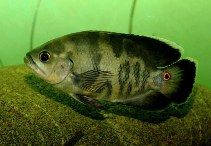
Spine dorsali (totale) : 12 - 14; Raggi dorsali molli (totale) : 17 - 21; Spine anali: 3; Raggi anali molli: 16 - 20. Large mouth with thick lips; 7 preopercular pores; first gill arch without lobe; gill rakers short and thick with many denticles; dorsal and anal fins bases densely scaled; many branched rays; body color dark with bright orange opercle margin and ventral parts of the lateral sides of the body; often a black rounded blotch with orange margin at caudal fin base (Ref. 35237).
Body shape (shape guide): short and / or deep; Cross section: oval.
Preferably inhabits quiet shallow waters in mud-bottomed and sand-bottomed canals and ponds (Ref. 5723). Feeds on small fish, crayfish, worms and insect larvae. Quite popular with aquarists but not for aquaculturists because of its slow growth (Ref. 35237). Maximum length 40 cm TL (Ref. 5723). A highly esteemed food fish in South America (Ref. 44091).
In captivity, both male and female clean a suitable spawning site - often a flat rock , or branches, or in a circular nest excavated in shallow water (Ref. 44091). Eggs (usually numbering in the thousands, Ref. 44091) are deposited and are guarded by both parents. Egg hatch in 3 or 4 days and parent move the fry to a shallow pit in the sand where they remain for 6 or 7 days (Ref. 7020).
Page, L.M. and B.M. Burr, 1991. A field guide to freshwater fishes of North America north of Mexico. Houghton Mifflin Company, Boston. 432 p. (Ref. 5723)
Stato della Lista Rossa IUCN (Ref. 130435: Version 2025-2 (Global))
Minaccia per l'uomo
Harmless
Usi umani
Pesca: commerciale; Pesce da pesca sportiva: si; Acquario: elevato interesse commerciale
Strumenti
Rapporti speciali
Scarica XML
Fonti Internet
Stime basate su modelli
Indice di diversità filogenetica (Fonte Biblio.
82804): PD
50 = 0.6250 [Uniqueness, from 0.5 = low to 2.0 = high].
Bayesian length-weight: a=0.03162 (0.01522 - 0.06569), b=3.02 (2.83 - 3.21), in cm total length, based on LWR estimates for this species & (Sub)family-body (Ref.
93245).
Livello trofico (Fonte Biblio.
69278): 2.8 ±0.32 se; based on food items.
Resilienza (Fonte Biblio.
120179): Alto, tempo minimo di raddoppiamento della popolazione meno di 15 mesi (Assuming tm<=1; Fec=300-2000).
Vulnerabilità della pesca (Ref.
59153): Moderate vulnerability (36 of 100).
🛈
Nutrienti (Ref.
124155): Calcium = 85.3 [39.6, 151.5] mg/100g; Iron = 1.15 [0.64, 2.32] mg/100g; Protein = 17.9 [16.4, 19.4] %; Omega3 = 0.318 [0.117, 0.926] g/100g; Selenium = 85.4 [31.6, 191.3] μg/100g; VitaminA = 25.4 [6.6, 80.9] μg/100g; Zinc = 1.63 [1.06, 2.47] mg/100g (wet weight);