>
Eupercaria/misc (Various families in series Eupercaria) >
Lutjanidae (Snappers) > Apsilinae
Etymology: Apsilus: Greek, apsilos, -e, -on = hairless, shorn, peeled (Ref. 45335).
More on author: Guichenot.
Entorno: milieu / zona climática / rango de profundidad / gama de distribución
Ecología
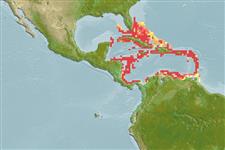
marino asociado a arrecife; rango de profundidad 40 - 300 m (Ref. 129909), usually 120 - 180 m (Ref. 55). Tropical; 29°N - 8°N, 98°W - 59°W
Western Central Atlantic: West Indies, Florida Keys, western Gulf of Mexico, western Caribbean (off Belize), probably more widespread in Caribbean (Anderson, pers. comm.).
Longitud en la primera madurez / Tamaño / Peso / Edad
Madurez: Lm 40.0 range ? - ? cm
Max length : 65.0 cm TL macho / no sexado; (Ref. 55); common length : 40.0 cm TL macho / no sexado; (Ref. 55); peso máximo publicado: 3.2 kg (Ref. 40637)
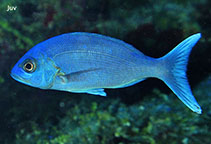
Espinas dorsales (total) : 10; Radios blandos dorsales (total) : 9 - 10; Espinas anales: 3; Radios blandos anales: 8. The snout is relatively short and pointed. Anterior teeth in upper jaw enlarged, canine-like. Interorbital space convex. Dorsal and anal fin bases without scales. Pectoral fins long reaching level of anus. Scale rows on back parallel to lateral line. The back and upper sides violet or dark brown becoming lighter ventrally. Juveniles are mainly blue in color.
Body shape (shape guide): fusiform / normal; Cross section: oval.
Adults inhabit mainly rocky bottoms. Young sometimes found near the surface. Feed on fishes and benthic organisms, including cephalopods and tunicates. Flesh of good quality; marketed fresh and frozen.
Ciclo vital y comportamiento de apareamiento
Madurez | Reproducción | Puesta | Huevos | Fecundidad | Larva
Allen, G.R., 1985. FAO Species Catalogue. Vol. 6. Snappers of the world. An annotated and illustrated catalogue of lutjanid species known to date. FAO Fish. Synop. 125(6):208 p. Rome: FAO. (Ref. 55)
Situación en la Lista Roja de la UICN (Ref. 130435: Version 2025-2 (Global))
Amenaza para el ser humano
Reports of ciguatera poisoning (Ref. 31172)
Usos humanos
Pesquerías: escaso valor comercial
Herramientas
Informes especiales
Descargar XML
Fuentes de Internet
Estimaciones basadas en modelos
Temperatura preferida (Referencia
123201): 19 - 23.7, mean 22.2 °C (based on 12 cells).
Índice de diversidad filogenética (Referencia
82804): PD
50 = 0.7500 [Uniqueness, from 0.5 = low to 2.0 = high].
Bayesian length-weight: a=0.01096 (0.00557 - 0.02158), b=3.02 (2.84 - 3.20), in cm total length, based on LWR estimates for this species & (Sub)family-body (Ref.
93245).
Nivel trófico (Referencia
69278): 4.1 ±0.52 se; based on food items.
Generation time: 1.7 ( na - na) years. Estimated as median ln(3)/K based on 1
growth studies.
Resiliencia (Referencia
120179): Medio, población duplicada en un tiempo mínimo de 1.4-4.4 años (K=0.3).
Vulnerabilidad pesquera (Ref.
59153): Low to moderate vulnerability (28 of 100).
🛈
Nutrientes (Ref.
124155): Calcium = 35.3 [19.0, 63.5] mg/100g; Iron = 0.653 [0.331, 1.126] mg/100g; Protein = 19.1 [17.2, 20.9] %; Omega3 = 0.17 [0.11, 0.28] g/100g; Selenium = 56.7 [32.8, 105.0] μg/100g; VitaminA = 68 [24, 230] μg/100g; Zinc = 0.757 [0.521, 1.091] mg/100g (wet weight);