>
Tetraodontiformes (Puffers and filefishes) >
Triacanthodidae (Spikefishes) > Triacanthodinae
Etymology: Paratriacanthodes: Greek, para in the side of + Greek, tres, tria = three + Greek, akantha = thorn (Ref. 45335).
More on author: Fowler.
Ambiente: milieu / zona climática / intervalo de profundidade / gama de distribuição
Ecologia
marinhas batidemersal; intervalo de profundidade 418 - 920 m (Ref. 33352). Deep-water
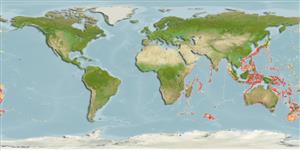
Indo-Pacific: East Africa, Japan, Kyushu-Palau Ridge, South China Sea, Australia, and south to New Caledonia and the Norfolk Ridge.
Tamanho / Peso / Idade
Maturidade: Lm ? range ? - ? cm
Max length : 12.0 cm SL macho/indeterminado; (Ref. 559)
Descrição breve
Chaves de identificação | Morfologia | Morfometria
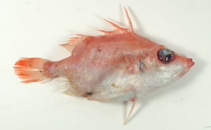
Espinhos dorsais (total) : 6; Raios dorsais moles (total) : 15; Espinhos anais: 0; Raios anais moles: 13. Reddish pink in color, with 3 pale lines, silvery blue from lower jaw to anus (Ref. 6660).
Body shape (shape guide): short and / or deep.
Ciclo de vida e comportamento de acasalamento
Maturidade | Reprodução | Desova | Ovos | Fecundidade | Larvas
Tyler, J.C., 1986. Triacanthodidae. p. 887-890. In M.M. Smith and P.C. Heemstra (eds.) Smiths' sea fishes. Springer-Verlag, Berlin. (Ref. 6660)
Categoria na Lista Vermelha da IUCN (Ref. 130435: Version 2025-2 (Global))
Ameaça para o homem
Harmless
Utilização humana
Ferramentas
Relatórios especiais
Descarregue XML
Fontes da internet
Estimativas baseadas em modelos
Temperatura preferida (Ref.
123201): 2.3 - 10.4, mean 7.9 °C (based on 364 cells).
Índice de diversidade filogenética (Ref.
82804): PD
50 = 0.6250 [Uniqueness, from 0.5 = low to 2.0 = high].
Bayesian length-weight: a=0.01995 (0.00906 - 0.04395), b=3.01 (2.83 - 3.19), in cm total length, based on all LWR estimates for this body shape (Ref.
93245).
Nível Trófico (Ref.
69278): 4.3 ±0.8 se; based on size and trophs of closest relatives
Vulnerabilidade da pesca (Ref.
59153): Low vulnerability (10 of 100).
🛈