Elasmobranchii (tubarões e raias) (sharks and rays) >
Carcharhiniformes (Ground sharks) >
Leptochariidae (Barbeled houndsharks)
Etymology: Leptocharias: Etymology not explained, perhaps leptos (Gr.), slender; [Car]charias, i.e., a slender shark “very nearly related to Carcharias” (See ETYFish); smithii: In honor of Andrew Smith (1797-1872), Scottish military physician, explorer, ethnologist and zoologist, who collected many South African sharks and coined many of the shark names later used by Müller and Henle (See ETYFish).
Eponymy: Dr Sir Andrew Smith (1797–1872) was a Scotsman who joined the Army Medical Service (1819) after graduating from Edinburgh University. [...] (Ref. 128868), visit book page.
More on authors: Müller & Henle.
Ambiente: milieu / zona climática / intervalo de profundidade / gama de distribuição
Ecologia
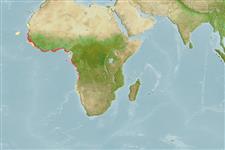
marinhas; estuarina demersal; intervalo de profundidade 10 - 75 m (Ref. 244), usually 10 - 60 m (Ref. 5377). Tropical; 20°C - 27°C; 22°N - 23°S, 26°W - 17°E
Eastern Atlantic: Mauritania to Namibia (Ref. 127434).
Tamanho / Peso / Idade
Maturidade: Lm ? range ? - ? cm
Max length : 77.0 cm TL macho/indeterminado; (Ref. 244); 82.0 cm TL (female); common length : 55.0 cm TL macho/indeterminado; (Ref. 26999)
Descrição breve
Chaves de identificação | Morfologia | Morfometria
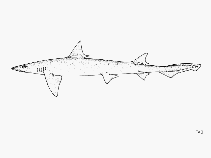
Similar to species of Mustelus but nostrils with anterior flaps formed into distinct barbels (Ref. 5485).
Body shape (shape guide): elongated.
Found on the continental shelf, especially abundant off river mouths on muddy bottoms. Salinity: 35-36 ppt. Oxygen: 3-4 ppm. Feeds on small bottom and littoral organisms like crustaceans, bony fishes, octopi and sponges. Viviparous (Ref. 50449), with 7 young in a litter (Ref. 244). Dental sexual dimorphism is manifested by males having greatly enlarged anterior teeth. Utilized fresh, smoked or dried salted for human consumption, skin for leather.
Ciclo de vida e comportamento de acasalamento
Maturidade | Reprodução | Desova | Ovos | Fecundidade | Larvas
Viviparous, placental (Ref. 50449), with 7 young in a litter (Ref. 244). Distinct pairing with embrace (Ref. 205).
Compagno, L.J.V., 1984. FAO Species Catalogue. Vol. 4. Sharks of the world. An annotated and illustrated catalogue of shark species known to date. Part 2 - Carcharhiniformes. FAO Fish. Synop. 125(4/2):251-655. Rome: FAO. (Ref. 244)
Categoria na Lista Vermelha da IUCN (Ref. 130435: Version 2025-2 (Global))
Ameaça para o homem
Harmless
Utilização humana
Pescarias: pouco comercial
Ferramentas
Relatórios especiais
Descarregue XML
Fontes da internet
Estimativas baseadas em modelos
Temperatura preferida (Ref.
123201): 19.2 - 28, mean 26 °C (based on 116 cells).
Índice de diversidade filogenética (Ref.
82804): PD
50 = 1.5000 [Uniqueness, from 0.5 = low to 2.0 = high].
Bayesian length-weight: a=0.00389 (0.00180 - 0.00842), b=3.12 (2.94 - 3.30), in cm total length, based on all LWR estimates for this body shape (Ref.
93245).
Nível Trófico (Ref.
69278): 3.8 ±0.49 se; based on food items.
Resiliência (Ref.
120179): Muito baixo, tempo mínimo de duplicação da população maior que 14 anos (Fec=7).
Vulnerabilidade da pesca (Ref.
59153): Moderate to high vulnerability (53 of 100).
🛈