Ambiente: milieu / zona climatica / distribuzione batimetrica / gamma di distribuzione
Ecologia
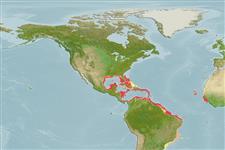
marino associati a barriera corallina; non migratori (Ref. 52884); distribuzione batimetrica 3 - 100 m (Ref. 7379). Subtropical; 33°N - 30°S, 99°W - 14°W
Western Atlantic: Florida, USA and Bahamas to Brazil, including the Gulf of Mexico and the Caribbean (Ref. 26938). Eastern Atlantic: off Ascension Island (Ref. 7379) and St. Paul's Rocks (Ref. 13121).
Lunghezza alla prima maturità / Dimensione / Peso / Età
Maturità: Lm 23.3, range 15 - 25 cm
Max length : 41.1 cm TL maschio/sesso non determinato; (Ref. 9626); common length : 28.0 cm TL maschio/sesso non determinato; (Ref. 3797); Età massima riportata: 27 anni (Ref. 118244)
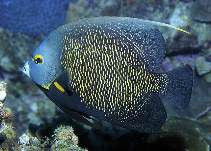
Spine dorsali (totale) : 10; Raggi dorsali molli (totale) : 29 - 31; Spine anali: 3; Raggi anali molli: 22 - 24. Black, the scales of the body , except those at front from nape to abdomen, rimmed with golden yellow; a broad orange-yellow bar at pectoral absent; dorsal filament yellow; chin whitish; outer part of iris yellow; eye narrowly rimmed below with blue (Ref. 13442)
Body shape (shape guide): short and / or deep; Cross section: compressed.
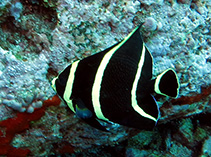
Adults are common in shallow reefs usually in pairs, often near sea fans (Ref. 9710). They feed on sponges, algae, bryozoans, zoantharians, gorgonians and tunicates (Ref. 9626). Oviparous (Ref. 240), monogamous (Ref. 52884). Spawning pairs are strongly territorial, with usually both members vigorously defending their areas against neighboring pairs (Ref. 38726). Juveniles tend cleaning stations where they service a broad range of clients, including jacks, snappers, morays, grunts, surgeonfishes, and wrasses. At the station the cleaner displays a fluttering swimming and when cleaning it touches the clients with its pelvic fins (Ref. 40094). Flesh considered good quality; marketed fresh (Ref. 3797). Has been reared in captivity (Ref. 35419).
Ciclo vitale e comportamento di accoppiamento
Maturità | Riproduzione | Deposizione | Uova | Fecondità | Larve
This species manifests apparent permanent pairing and monogamy. During most of the observation period, a single pair swam slowly in a side-to-side orientation at a height of 25 to 75 cm above the reef. No conspicuous courtship displays were evident, nor was there any evidence of sexual identity, i.e., the female was not obviously swollen with eggs. Shortly after sunset, the pair ascended in a broad, shallow arc off the bottom, traversing approximately 7 to 10 m while ascending to a height of 2 to 3 m. As the pair ascended, each angled its body slightly, with their venters in close proximity, if not actually touching. This position was held throughout the peak of the arc, with the pair diverging on the descent. Other pairs in the area were seen making similar arcing movements elsewhere on the reef at approximately the same time. It was difficult to see if there were gametes released in the event. There was no interference between pairs during spawning. Monogamous mating is observed as both obligate and social (Ref. 52884).
Allen, G.R., 1985. Butterfly and angelfishes of the world. Vol. 2. 3rd edit. in English. Mergus Publishers, Melle, Germany. (Ref. 4858)
Stato della Lista Rossa IUCN (Ref. 130435: Version 2025-2 (Global))
Minaccia per l'uomo
Reports of ciguatera poisoning (Ref. 30303)
Usi umani
Pesca: scarso interesse commerciale; Acquario: Commerciale
Strumenti
Rapporti speciali
Scarica XML
Fonti Internet
Stime basate su modelli
Temperatura preferita (Fonte Biblio.
123201): 22.9 - 28, mean 26.6 °C (based on 410 cells).
Indice di diversità filogenetica (Fonte Biblio.
82804): PD
50 = 0.5001 [Uniqueness, from 0.5 = low to 2.0 = high].
Bayesian length-weight: a=0.03715 (0.02076 - 0.06650), b=2.92 (2.77 - 3.07), in cm total length, based on LWR estimates for this species & Genus-body shape (Ref.
93245).
Livello trofico (Fonte Biblio.
69278): 2.8 ±0.0 se; based on diet studies.
Generation time: 9.2 ( na - na) years. Estimated as median ln(3)/K based on 2
growth studies.
Resilienza (Fonte Biblio.
120179): Basso, tempo minimo di raddoppiamento della popolazione 4.5 - 14 anni (K=0.12-0.21; tmax=27;).
Vulnerabilità della pesca (Ref.
59153): Moderate vulnerability (39 of 100).
🛈
Nutrienti (Ref.
124155): Calcium = 27.3 [12.3, 50.1] mg/100g; Iron = 0.534 [0.310, 0.915] mg/100g; Protein = 19.1 [17.9, 20.2] %; Omega3 = 0.157 [0.092, 0.269] g/100g; Selenium = 19.1 [9.3, 37.8] μg/100g; VitaminA = 30.8 [7.5, 115.5] μg/100g; Zinc = 0.777 [0.506, 1.173] mg/100g (wet weight);