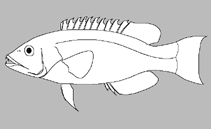
การจำแนกประเภท / ชื่อ
ชื่อสามัญ | ชื่อพ้อง | Catalog of Fishes(สกุล, ชนิด) | ITIS | CoL | WoRMS | Cloffa
>
Eupercaria/misc (Various families in series Eupercaria) >
Labridae (Wrasses) > Julidinae
Etymology: Halichoeres: Greek, als, alis = salt + Greek, choiros = pig (Ref. 45335); burekae: Named for Joyce Burek, who first photographed the terminal phase male of this species.
Eponymy: Joyce Burek and her husband Frank are wildlife photographers whose specialty is marine subjects. [...] (Ref. 128868), visit book page.
สิ่งแวดล้อม : สิ่งแวดล้อม / เขตภูมิอากาศ / ระดับความลึก / ระยะการกระจายสินค้า
นิเวศวิทยา
เกี่ยวกับทะเล,น้ำเค็ม เกี่ยวกับหินโสโครก; ระดับความลึก ? - 24 m (Ref. 75768). Subtropical
Western Atlantic: Gulf of Mexico.
ขนาด / น้ำหนัก / อายุ
วัยเจริญพันธุ์: Lm ? range ? - ? cm
Max length : 7.7 cm SL เพศผู้/กระเทย; (Ref. 75768)
Collected over claystone, sponge, and coral substrata. Adults were observed in small schools along the reef crest mixed with Thalassoma bifasciatum, juvenile Bodianus rufus, and Chromis multilineata, while small juveniles ((12-18 mm TL) were observed in mixed schools with juvenile Clepticus parrae. It feeds mainly on calanoid copepods and other plankton. During courtship, terminal phase males: raise the dorsal 'flag' while approaching a female and keep the dorsal fin erect while in close proximity to her; primarily use pectoral ‘'labriform' propulsion for locomotion unless making rapid rushes at a female from a distance, in which case the caudal fin and body are used for rapid propulsion to pursue her; typically circles the female with dorsal fin flared, also periodically flaring the caudal lobes; and, were observed to nip the female on the fins. Agonistic interactions were also observed between males, approaching each other with flaring gill plates and jaws, and rapidly fanning their pectoral fins (Ref. 75768).
วงจรชีวิตและพฤติกรรมการผสมพันธุ์
วัยเจริญพันธุ์ | การสืบพันธุ์ | การวางไข่ | เซลสืบพันธ์ของเพศเมีย(ไข่) | ความดกของไข่ | ตัวอ่อน
Weaver, D.C. and L.A. Rocha, 2007. A new species of Halichoeres (Teleostei: Labridae) from the Western Gulf of Mexico. Copeia 2007(4):798-807. (Ref. 75768)
สถานะบัญชีแดงของ IUCN (Ref. 130435: Version 2025-2 (Global))
ภัยคุกคามต่อมนุษย์
Harmless
การใช้ของมนุษย์
เครื่องมือ
รายงานพิเศษ
ดาวน์โหลด XML
แหล่งที่มาจากอินเตอร์เน็ต
การประมาณค่าตามแบบจำลอง
ดัชนีความหลากหลายทางวิวัฒนาการ (อ้างอิง
82804): PD
50 = 0.5000 [Uniqueness, from 0.5 = low to 2.0 = high].
Bayesian length-weight: a=0.01000 (0.00475 - 0.02106), b=3.09 (2.92 - 3.26), in cm total length, based on LWR estimates for this Genus-body shape (Ref.
93245).
ระดับชั้นอาหาร (อ้างอิง
69278): 3.3 ±0.5 se; based on size and trophs of closest relatives
ความสามารถในการกลับคืนสู่ปกติ (อ้างอิง
120179): ความสูง, เวลาต่ำสุดที่จะทำให้ประชากรเพิ่มขึ้นเป็น 2 เท่าใช้เวลาน้อยกว่า 15 เดือน (Preliminary K or Fecundity.).
ความเสี่ยงต่อการตกปลา (Ref.
59153): Low vulnerability (10 of 100).
🛈