>
Perciformes/Serranoidei (Groupers) >
Anthiadidae (Fairy basslets or Streamer basses)
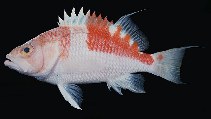
Etymology: Zalanthias: Jordan and Richardson (1910) did not specify the meaning of Zalanthias. However, ‘zal’ might derive from the Greek word ζᾰ’λη, meaning storm or downpour. The connection between this term and the genus name remains unclear; kelloggi: Named after Dr. Vernon Lyman Kellog, professor of entomology at Stanford University.
Eponymy: Vernon Lyman Kellogg (1867–1937) was an entomologist, evolutionary biologist and science administrator at Stanford University. [...] (Ref. 128868), visit book page.
More on authors: Jordan & Evermann.
Taxonomic Remarks
The placement of this species follows Randall (1980: Ref. 8944). Smith and Craig placed it in Zalanthias in Serraninae upon a molecular study of Serranidae. It was replaced in Plectranthias by Anderson and Heemstra (2012: Ref. YYY) and confirmed Parenti and Randall (2020: Ref. YYY) but without further evidence. A reassessment based both on molecular and morphological data is needed. More studies are need, or please sned references.
Ambiente: milieu / zona climática / intervalo de profundidade / gama de distribuição
Ecologia
marinhas demersal. Temperate
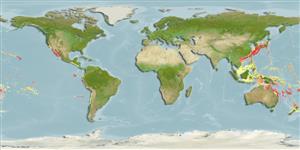
Central Pacific: Hawaiian Islands and other islands and seamounts northwest along the Hawaiian Ridge to the southern Emperor Seamount Chain.
Tamanho / Peso / Idade
Maturidade: Lm ? range ? - ? cm
Max length : 10.3 cm SL macho/indeterminado; (Ref. 137577)
Ciclo de vida e comportamento de acasalamento
Maturidade | Reprodução | Desova | Ovos | Fecundidade | Larvas
Randall, J.E., 1980. Revision of the fish genus Plectranthias (Serranidae: Anthiinae) with description of 13 new species. Micronesia 16(1):101-187. (Ref. 8944)
Categoria na Lista Vermelha da IUCN (Ref. 130435: Version 2025-2 (Global))
Ameaça para o homem
Harmless
Utilização humana
Pescarias: de interesse potencial
Ferramentas
Relatórios especiais
Descarregue XML
Fontes da internet
Estimativas baseadas em modelos
Temperatura preferida (Ref.
123201): 8.4 - 22.7, mean 18.1 °C (based on 165 cells).
Índice de diversidade filogenética (Ref.
82804): PD
50 = 0.5020 [Uniqueness, from 0.5 = low to 2.0 = high].
Bayesian length-weight: a=0.02512 (0.00978 - 0.06451), b=2.98 (2.75 - 3.21), in cm total length, based on LWR estimates for this (Sub)family-body shape (Ref.
93245).
Nível Trófico (Ref.
69278): 3.4 ±0.4 se; based on size and trophs of closest relatives
Resiliência (Ref.
120179): Elevada, tempo mínimo de duplicação da população menor que 15 meses (Preliminary K or Fecundity.).
Vulnerabilidade da pesca (Ref.
59153): Low vulnerability (10 of 100).
🛈